
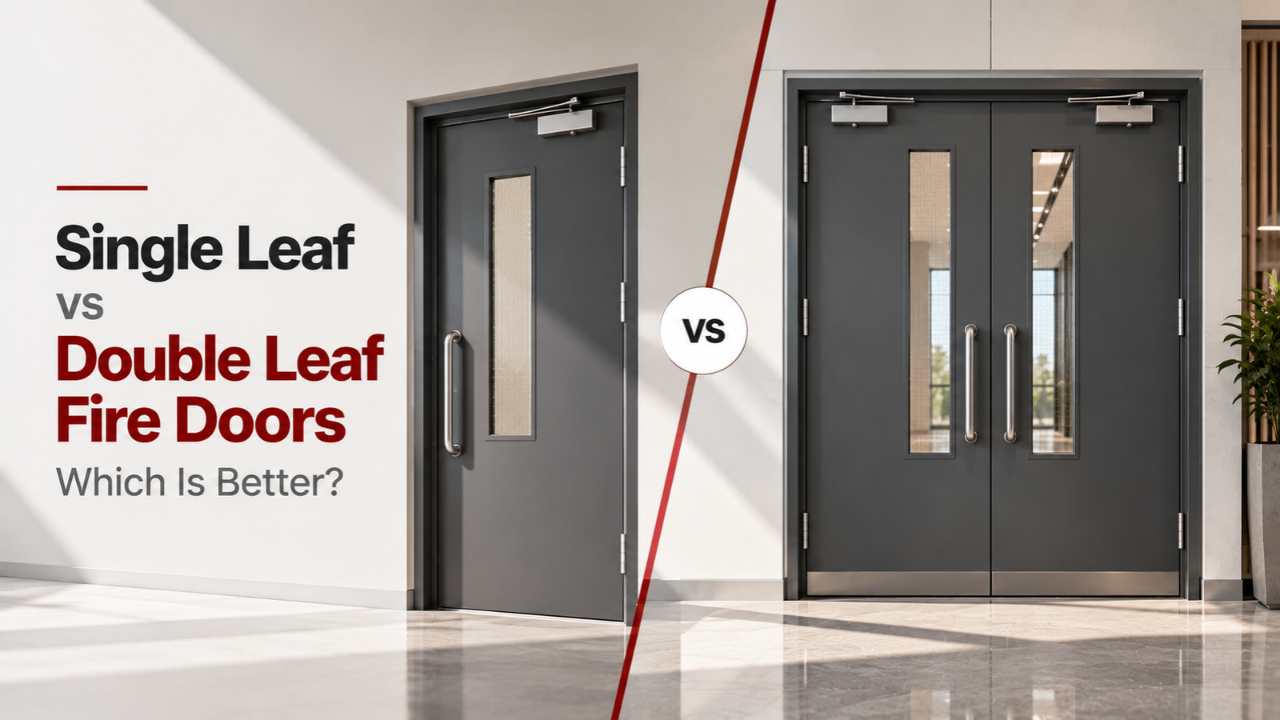

Few fire door decisions generate as much quiet confusion as this one. On paper, the question looks simple: do you need one door leaf or two? In practice, the answer shapes your fire performance, hardware complexity, maintenance burden, evacuation capacity, and budget — and getting it wrong can mean a door that looks compliant but fails at the one point it was never properly designed to hold: the gap between the two leaves.
The common assumption — that a double leaf fire door is simply “two single doors side by side” — is the single most persistent misconception in this area, and it’s the reason many double-leaf installations fail inspection even when both leaves individually carry valid fire ratings. This guide breaks down what actually separates single and double leaf fire doors, where each one genuinely makes sense, and how to decide which is right for your project.
What Are Single Leaf and Double Leaf Fire Doors?
A single leaf fire door consists of one door panel (leaf) hung in a frame, opening on its own set of hinges. It’s the standard configuration for most individual rooms, plant rooms, flat entrances, and any opening narrow enough for one leaf to cover practically.
A double leaf fire door (sometimes called a pair or double-door set) consists of two leaves meeting at a central point, called the meeting stile, within a single wider frame. Double leaf doors come in a few configurations:
- Equal leaf: both leaves are the same width, common in corridors and standard commercial applications
- Unequal leaf (sometimes called “leaf and a half”): one leaf is wider than the other, typically so the wider active leaf handles day-to-day traffic while the narrower inactive leaf stays closed except when a wider opening is needed
- Double-egress: both leaves swing in both directions, typically for high-traffic internal circulation
The active leaf is the one used for normal daily passage; the inactive (or passive) leaf is secured closed — typically with flush bolts at the head and threshold — and opened only when full width is needed, such as moving equipment or beds through.
The Most Important Point: A Double Door Is Not Two Single Doors
Here’s the principle that underlies almost everything else in this comparison: a double leaf fire door is a complete, distinct fire-resisting assembly in its own right. Its fire performance depends on the whole configuration — both leaves, the meeting stile detail, the seals, the hardware sequence, and the frame — tested together as a single system, not on the rating printed on each individual leaf.
This has a practical consequence that surprises many specifiers: two certified single doors do not automatically make a certified pair. A single fire door has one leaf-to-frame relationship to get right. A double fire door has two of those relationships plus a third, more fragile interface — the point where the two leaves meet each other. That meeting stile is where most double-door performance problems originate, and it’s the reason double leaf doors need more careful specification, hardware selection, and installation than their single leaf counterparts.
Can Both Achieve the Same Fire Rating?
Yes — both single and double leaf fire doors can be manufactured and certified to the same fire-resistance ratings (FD30, FD60, FD90, FD120 in the Indian context under IS 3614:2021). The rating itself isn’t what separates them. What differs is how many things have to go right for that rating to actually be achieved in the field:
- A single leaf door relies on one set of leaf-to-frame seals, one closer, and one latching mechanism.
- A double leaf door relies on two sets of leaf-to-frame seals, typically two closers, a coordinator to control closing sequence, flush bolts securing the inactive leaf, a meeting-stile seal (often an astragal or specific edge profile), and correct latching of the active leaf against that meeting edge.
Both can pass the same furnace test. But the double configuration has meaningfully more potential points of failure after installation, which is why the practical comparison between the two is really about risk, maintenance, and fit-for-application rather than raw rating capability.
Key Differences at a Glance
| Factor | Single Leaf | Double Leaf |
|---|---|---|
| Typical clear width | Narrower — suited to one leaf of practical width | Wider — typically needed where openings exceed what one leaf can practically span |
| Fire rating achievable | FD30–FD120 | FD30–FD120 (as a complete tested pair) |
| Hardware complexity | Lower — one closer, one latch set | Higher — two closers, coordinator, flush bolts, astragal/meeting seal |
| Failure points | Fewer — one leaf-to-frame interface | More — adds the meeting stile and sequencing risk |
| Cost | Lower | Typically meaningfully higher than a single door of the same rating, since there’s more leaf, hardware, and frame involved |
| Maintenance burden | Lighter | Heavier — more moving parts to inspect, adjust, and keep aligned |
| Evacuation/traffic capacity | Limited by single-leaf width | Higher, especially when both leaves can open |
| Best suited to | Individual rooms, flat entrances, plant rooms, narrower openings | Corridors, lobbies, wards, large openings, equipment/bed movement |
Advantages and Disadvantages of Single Leaf Fire Doors
Advantages:
- Fewer failure points. With one leaf, one frame relationship, and no meeting stile, there’s simply less that can go wrong over years of use.
- Simpler, cheaper hardware. One closer, one latch set, no coordinator or flush bolts to specify, match, and maintain.
- Lower cost for the same fire rating, both at purchase and over the door’s life.
- Easier maintenance and inspection. A single door is quicker to inspect, adjust, and verify compliant.
- Less wear from repetitive cycling. With fewer interacting components, single leaf systems tend to experience less alignment drift and mechanical stress over time.
Disadvantages:
- Width limits. A single leaf can only practically span so much width before weight, sagging, and usability become problems — large single leaves are heavy, harder to operate, and more prone to hinge stress.
- Limited clear opening for moving beds, equipment, or goods without making the door impractically large.
- Lower throughput in high-traffic corridors where a wider opening would otherwise allow smoother two-way movement.
Advantages and Disadvantages of Double Leaf Fire Doors
Advantages:
- Wider clear opening without needing an oversized, unwieldy single leaf — important for bed movement, equipment, and goods in hospitals, hotels, industrial buildings, and commercial corridors.
- Flexibility in use. An unequal leaf configuration lets staff use the narrower, everyday active leaf for normal traffic while opening both leaves only when full width is needed.
- Better traffic flow in high-footfall corridors and lobbies.
- Practical for large openings where a single leaf would be too heavy or prone to sagging to remain reliable.
Disadvantages:
- Meeting stile complexity. The interface between the two leaves is the most failure-prone part of any pair, and demands precise sealing and sequencing.
- More hardware, more cost. Two closers, a coordinator, flush bolts, and an astragal or equivalent meeting-edge detail all add to purchase cost and long-term maintenance.
- Higher sensitivity to misalignment. Sagging, hinge wear, or frame movement affects the meeting stile gap far more noticeably than it would affect a single leaf-to-frame gap.
- Stricter hardware interdependence. Unlike a single door, where a missing closer might be swapped with a similar unit, double door hardware operates as an interdependent system — coordinator arm length, astragal handing, and flush bolt alignment all have to match the specific leaf configuration.
Understanding the Meeting Stile: Astragal, Coordinator, and Flush Bolts
Three hardware elements do most of the heavy lifting at the meeting stile of a double leaf fire door, and understanding each one explains most of the difference between a pair that works and one that fails inspection.
The Astragal
An astragal is a vertical strip attached to the meeting edge of one leaf, sealing the gap between the two leaves against smoke, flame, and hot gases. It isn’t decorative — on many double fire door designs, the astragal is a core part of how the meeting stile achieves its tested fire and smoke performance, and where the tested configuration specifies one, it must be present, correctly handed to match the active leaf, and undamaged.
The Coordinator
A door coordinator controls the closing sequence of a pair, ensuring the inactive leaf closes before the active leaf so the active leaf can latch properly against the meeting edge. Without it, the active leaf can reach the meeting stile first, blocking the inactive leaf from fully closing and leaving a gap at the center of the door. This is why a coordinator is considered essential on rebated pairs and strongly recommended even on square-edged ones where an active latching leaf is used — and why Indian code guidance for commercial buildings specifically calls for coordinator devices on double-leaf fire doors.
For unequal-leaf pairs, coordinator mounting also matters: it needs to be set up so the narrower leaf is held back appropriately while the wider leaf engages its flush bolts before the meeting edge closes — a detail that’s easy to get wrong if a coordinator is simply fitted without reference to the specific leaf configuration.
Flush Bolts
Flush bolts secure the inactive leaf at the head and threshold, holding it fixed closed so the active leaf has a stable, solid surface to latch against. They need to be fire-rated, correctly aligned with the strike preparation in the frame, and engaged properly — a loose or disengaged inactive leaf is a common finding during inspections.
Why Double Leaf Fire Doors Fail Inspection So Often
Several recurring problems account for most double leaf fire door failures in the field — and they tie directly back to the common causes of fire door failure more broadly:
- Closing sequence failure. If the inactive leaf doesn’t fully latch before the active leaf makes contact, the gap at the meeting stile can exceed the allowable limit for smoke and flame penetration, even though both leaves are individually compliant.
- Missing, damaged, or wrongly handed astragal. Where the tested configuration requires an astragal, its absence or incorrect installation can directly compromise the meeting stile seal.
- Hardware substitution. Because double door hardware is an interdependent system, swapping a closer or coordinator for a generic equivalent can quietly break the sequencing the whole assembly depends on.
- Sagging and alignment drift. Wide pairs carry more weight and are more sensitive to hinge wear and frame movement, which tends to show up first at the meeting stile as an uneven or widening gap.
- Treating the pair as two independent doors. Specifiers and installers used to single doors sometimes assume both leaves just need to close independently, which guarantees misalignment and inspection rejection.
Size Limits: Why Total Opening Width Alone Doesn’t Prove Compliance
One of the more subtle issues with double leaf fire doors is that a given total opening width being “within limits” doesn’t automatically mean a specific double leaf configuration is approved. Tested size boundaries for pairs depend on the individual leaf sizes, whether the split is equal or unequal, the meeting stile detail, the hardware arrangement, and the specific approved configuration documented in that door’s test report and shop drawings.
In the Indian context, IS 3614:2021 sets maximum permissible opening dimensions for hinged metallic fire doorsets — commonly cited as a maximum wall opening area of roughly 7.2 m², with width and height caps of around 2.4 m and 3.0 m respectively — but even within those outer limits, the specific doorset configuration you’re buying must match a tested, certified arrangement from the manufacturer. Always confirm the exact approved leaf sizes and configuration against the manufacturer’s test certificate and drawings, rather than assuming any combination within the standard’s outer limits is automatically compliant.
When to Choose a Single Leaf Fire Door
Single leaf fire doors are typically the right choice when:
- The opening is narrow enough for one leaf to cover practically and operate easily
- The application is an individual room, flat entrance, plant room, store, or service space
- Traffic is light to moderate and doesn’t require a wider opening for beds, equipment, or goods
- Minimizing hardware complexity, maintenance burden, and cost is a priority
- The location is hard to inspect frequently, where fewer failure points reduce long-term risk
A useful rule of thumb: wherever the opening width reasonably permits a single leaf, a single leaf is generally the lower-risk, lower-cost, lower-maintenance choice.
When to Choose a Double Leaf Fire Door
Double leaf fire doors make sense when:
- The opening exceeds what a single leaf can practically span — often cited around 1000 mm or wider in practice.
- Beds, trolleys, or equipment need to pass through, as in hospital wards, ICU corridors, and clinical areas where wider clear openings are an operational necessity.
- High-traffic corridors, hotel hallways, and lobbies benefit from a wider opening for two-way flow.
- Industrial and warehouse openings need to accommodate goods, forklifts, or large equipment while still maintaining fire compartmentation.
- Assembly spaces and banquet areas need wider exit doors to accommodate larger occupant loads moving through at once.
In these applications, a well-specified, correctly maintained double leaf door is not only acceptable — it’s the more practical, usable solution, as long as the hardware, seals, and sequencing are treated as the critical system they are.
Egress, Code, and Practical Considerations in India
A few Indian code and practical points are worth keeping in mind when choosing between the two:
- NBC 2016 Part 4 calls for coordinator devices on double-leaf fire doors in commercial and similar buildings, and expects corridor fire doors to close automatically — meaning a double door’s closing sequence isn’t optional hardware, it’s a code-linked requirement.
- Door width requirements scale with occupant load and use. Minimum exit doorway widths, wider openings for bed evacuation in hospital ICUs, and larger exits for assembly spaces all influence whether a single or double configuration is practical for a given location.
- Swing direction matters. Doors in escape routes generally need to swing in the direction of exit travel, and hospital design guidance commonly favors doors that swing into rooms rather than into corridor traffic, which affects how double leaf configurations are laid out.
- Certification and labelling still apply. A double leaf doorset needs its own certification label, manufacturer details, and test documentation covering the complete pair — not just a label on each individual leaf.
Cost Considerations: Beyond the Leaf
The price difference between single and double leaf fire doors is rarely just “twice the door.” Beyond the additional leaf itself, a double leaf set typically adds a second set of hinges and closers, a coordinator, flush bolts, an astragal or meeting-edge detail, and a wider, more robust frame to carry the additional weight and span. Market pricing varies widely by manufacturer, rating, finish, and configuration, but it’s reasonable to expect a pair to cost meaningfully more than a single door of the same rating.
More important than purchase price is lifecycle cost. A double leaf door’s higher hardware count and sensitivity to alignment can mean more frequent adjustment, maintenance, and inspection effort over its lifetime. For a building with a large inventory of fire doors — hotels, hospitals, large commercial towers — that long-term maintenance load is worth factoring into configuration decisions upfront, not discovered later.
Common Mistakes When Specifying Single or Double Leaf Fire Doors
- Treating a double leaf door as two independent single doors, overlooking the meeting stile, coordinator, and sequencing requirements.
- Omitting the coordinator on a pair that needs one, leaving the closing sequence to chance.
- Fitting the wrong astragal, or one with the wrong handing for the active leaf configuration.
- Substituting generic hardware for the specified, certified closers, coordinators, or flush bolts on a pair.
- Assuming total opening width within the standard’s outer limits means any leaf split is approved, without checking the manufacturer’s tested configuration.
- Over-specifying double leaf doors where a single leaf would do, adding unnecessary cost, hardware, and maintenance burden.
- Under-specifying single leaf doors in locations that actually need wider clear openings, leading to oversized, heavy leaves that sag and wear prematurely.
- Neglecting inspection of the meeting stile gap during routine maintenance, since it’s often the first place alignment drift shows up.
A Practical Decision Checklist
- ✅ Measure the actual clear opening width needed, including any bed, trolley, or equipment movement requirements
- ✅ Check whether a single leaf can practically and comfortably cover that width without becoming oversized or heavy
- ✅ Confirm the required fire rating (FD30/60/90/120) and ensure the chosen configuration is tested and certified at that rating
- ✅ For double leaf doors, verify the exact approved leaf sizes, astragal, coordinator, and flush bolt arrangement against the manufacturer’s test certificate and shop drawings
- ✅ Confirm self-closing devices (and a coordinator, for pairs) are specified and compatible with the leaf configuration
- ✅ Factor in lifecycle maintenance and inspection capacity, especially for large inventories of double leaf doors
- ✅ Verify certification, labelling, and documentation cover the complete doorset, not just individual leaves
- ✅ Plan inspection routines that specifically check the meeting stile gap, coordinator function, and flush bolt engagement on every pair
So, Which Is Better?
Neither configuration is inherently better — they solve different problems. A single leaf fire door is the better choice wherever the opening width allows it, because it offers fewer failure points, simpler hardware, lower cost, and easier long-term maintenance. A double leaf fire door is the better choice wherever the opening width, traffic volume, or equipment/bed movement genuinely requires a wider opening — provided the meeting stile, coordinator, astragal, and hardware are all specified, installed, and maintained as the interdependent system they are.
The real mistake isn’t picking the “wrong” configuration; it’s picking a double leaf door and then treating it like a single door, or picking a single leaf door for an opening that’s too wide for it to work reliably. Match the configuration to the opening, specify the full hardware system, and verify the tested configuration — and either choice will perform exactly as it should.
Quick Recap
- A double leaf fire door is a complete assembly in its own right, not two single doors side by side — its performance depends on the meeting stile, seals, and hardware sequencing as much as on each leaf’s rating.
- Both single and double leaf doors can achieve the same fire ratings, but double leaf doors carry more potential failure points and a heavier maintenance burden.
- Coordinators, astragals, and flush bolts are critical elements of a double leaf set, not optional extras.
- Single leaf is the better default wherever the opening width allows; double leaf is the right choice for wide openings, bed and equipment movement, and high-traffic corridors.
- Always verify the exact tested configuration — leaf sizes, hardware, and meeting stile detail — against the manufacturer’s certification, not just the overall opening dimensions.
FAQs
Is a double leaf fire door as safe as a single leaf fire door? Both can achieve the same certified fire ratings when specified, installed, and maintained correctly. However, double leaf doors have more potential failure points — particularly at the meeting stile — so they depend more heavily on correct hardware, sequencing, and ongoing maintenance to perform as tested.
Do double leaf fire doors always need a coordinator? A coordinator is considered essential for rebated pairs and strongly recommended for others where an active leaf latches against the meeting edge, and NBC 2016-based guidance calls for coordinator devices on double-leaf fire doors in commercial buildings. Double-egress pairs, where both leaves swing independently, function differently and may not require one.
What is an astragal on a fire door? An astragal is a vertical strip fitted to the meeting edge of one leaf on a double door, sealing the gap between the two leaves against smoke, flame, and hot gases. Where a door’s tested configuration specifies one, it must be present and correctly installed.
Can I use two certified single fire doors as a double door? Not automatically. Fire doors are tested as complete assemblies, and a pair has a meeting stile interface that single doors don’t — so two certified single doors don’t make a certified pair unless that specific pair configuration has been tested and approved.
How wide can a single leaf fire door be? There’s no single universal figure, since it depends on the tested configuration, manufacturer, and rating, and IS 3614:2021 sets outer limits for hinged metallic fire doorsets. In practice, single leaves become impractical beyond around 1000 mm in width because of weight and usability, which is where double leaf configurations typically take over.
Which is cheaper, single or double leaf fire doors? Single leaf doors are generally cheaper, since a double leaf set adds a second leaf, more hardware (closers, coordinator, flush bolts), an astragal or meeting-edge detail, and a wider frame. Exact pricing varies widely by manufacturer, rating, and configuration.
Do double leaf fire doors need more maintenance? Yes. With more moving parts and a meeting stile that’s sensitive to alignment drift, double leaf doors generally need closer attention — including regular checks of the meeting gap, coordinator function, flush bolt engagement, and astragal condition.
Which type is better for hospitals and hotels? Hospitals and hotels commonly use both: double leaf doors in wide corridors and wards where beds or equipment need to pass, and single leaf doors for individual rooms and service spaces. The right choice depends on the specific opening, traffic, and clearance requirements.
Choosing between single and double leaf fire doors comes down to matching configuration to opening — and then specifying, certifying, and maintaining the complete system properly. Pacific Fire Doors manufactures BIS-certified single leaf and double leaf fire-rated doorsets under IS 3614:2021, tested as complete assemblies with the coordinators, astragals, and hardware that wider openings demand — giving architects, contractors, and facility teams a certified, documented starting point whichever configuration a project calls for.