
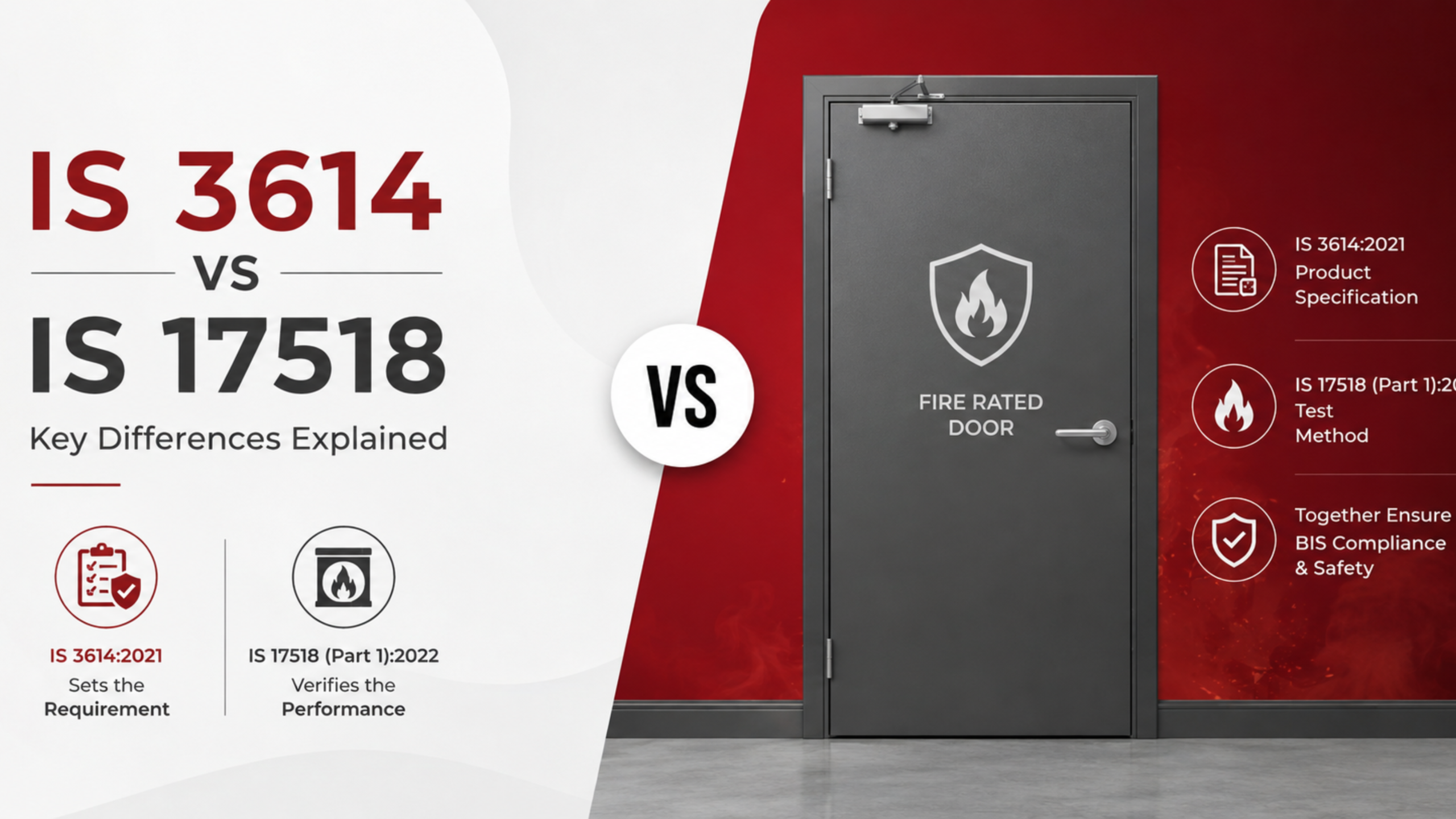

If you manufacture, specify, or purchase fire-rated doors in India, you’ve probably come across two standard numbers again and again: IS 3614 and IS 17518. Architects ask for them in tender documents, BIS certificates reference both, and test reports quote them side by side. Naturally, a lot of people assume they’re two competing standards for the same thing — or worse, that one has replaced the other.
They haven’t. They do two completely different jobs, and understanding that difference is the key to understanding how fire door certification in India actually works — and why so many “fire doors” sold in the market today aren’t actually compliant with either.
This guide breaks it down in plain language, covers where each standard came from, how they interact in practice, and what you should actually check before trusting a fire door label.
The Short Answer
IS 3614:2021 is the product specification — it tells a manufacturer what a fire door must be made of, how it must be constructed, and what performance it must achieve.
IS 17518 (Part 1):2022 is the test method — it tells a laboratory exactly how to test that door in a furnace to check whether it actually meets the fire resistance claim.
In other words: IS 3614 sets the requirement, IS 17518 verifies it. One cannot function without the other. A door isn’t “IS 3614 certified” unless it has been tested using the procedure laid out in IS 17518.
Think of it like an exam. IS 3614 is the syllabus — it tells you what a student (the door) needs to know and demonstrate. IS 17518 is the actual exam paper and grading rubric — it tells the examiner exactly how to test that knowledge and decide pass or fail.
A Bit of Background: Why Two Standards Exist
Before India developed its own dedicated fire door testing standard, manufacturers and labs largely depended on foreign testing protocols — commonly British Standard BS 476 or European Standard EN 1634 — to determine fire resistance ratings. This created inconsistency: two doors tested under different foreign methodologies weren’t always directly comparable, and there was no single Indian benchmark tying product specification to test methodology.
The Bureau of Indian Standards, through its Civil Engineering Department committee (CED 36), addressed this gap in two stages. IS 3614 has existed in earlier forms for years as the core product specification, with the 2021 revision bringing major updates aligned with modern fire door construction, testing philosophy, and classification. IS 17518 (Part 1):2022 arrived later as a dedicated, India-specific test method standard, harmonised with the international ISO 3008-1 protocol. This gave India a complete, self-contained certification loop: a specification standard and a matching test standard, both under the same committee, both mutually referencing each other.
What Is IS 3614:2021?
IS 3614:2021, published by BIS, is titled “Fire Doors and Doorsets — Specification.” It is the primary product standard for fire-rated doors sold in India and covers:
- Materials permitted for metallic and timber fire doors, referencing supporting material standards like IS 277 (galvanised steel sheet), IS 513 (cold-rolled steel sheet), IS 16074 (hollow metal doors), and IS 4351 (steel door frames)
- Construction requirements — core material composition, frame design, seals and intumescent strips, glazing and vision panels, and hardware compatibility
- Classification of fire doors by rating: FD 30, FD 60, FD 90, and FD 120, corresponding to 30, 60, 90, and 120 minutes of fire resistance, further split into:
- UD – Uninsulated Doors
- PI – Partially Insulated Doors
- ID – Fully Insulated Doors
- Marking and labelling requirements, including mandatory display of the BIS Standard Mark on every certified door
- Scheme of Inspection and Testing (Annex C), which lays out the quality control system a licensed manufacturer must maintain — in-process checks on every consignment, calibrated test equipment, maintained test records, and periodic re-testing (typically every 5 years) to retain the license
Essentially, if someone asks “does this door qualify as a legitimate fire door in India,” IS 3614:2021 is the rulebook that answers that question. It is the document architects cite in specifications, the document BIS licenses are issued against, and the document that determines what actually gets manufactured on the factory floor.
What Is IS 17518 (Part 1):2022?
IS 17518 (Part 1):2022 is titled “Fire Resistance Tests — Door and Shutter Assemblies — Part 1: General Requirements.” It was introduced to give India its own harmonised, internationally aligned testing methodology, replacing the earlier patchwork reliance on foreign furnace-test protocols.
IS 17518 is technically identical to (adopted from) ISO 3008-1, which means Indian fire resistance test data is now benchmarked against a globally recognised protocol — a meaningful advantage for manufacturers with export ambitions or international clients. It covers:
- The standard time-temperature heating curve used inside the test furnace, ensuring every lab applies identical thermal exposure conditions
- Mechanical pre-conditioning (“cycling”) of the door assembly before the fire test, simulating years of real-world opening and closing wear before the door is even exposed to heat
- Measurement methods for the three core performance criteria:
- Integrity (E) — whether the door stops flames and hot gases from passing through
- Insulation (I) — whether the unexposed face stays below a safe temperature threshold
- Radiation control (W), where applicable — whether radiant heat transfer stays within limits
- Failure criteria that precisely define the exact moment a door assembly is considered to have failed the test — critical for determining whether a door achieves FD 60 versus FD 90, for example
- Applicability across door types: hinged and pivoted doors, horizontally and vertically sliding doors (including sectional and articulated sliding doors), steel single-skin folding shutters, tilting doors, rolling shutter doors, and removable wall panels
Part 1 is the general requirements section applicable to most building fire doors. A separate part of the standard (Part 2) deals specifically with lift landing doors, which face different fire exposure dynamics due to the vertical shaft they protect — but that’s a more specialised discussion for another day.
Where IS 3614 sets the finish line, IS 17518 defines the exact race track, stopwatch rules, and judging criteria used to see if the door crosses it.
IS 3614 vs IS 17518: Side-by-Side Comparison
| Aspect | IS 3614:2021 | IS 17518 (Part 1):2022 |
| Full title | Fire Doors and Doorsets — Specification | Fire Resistance Tests — Door and Shutter Assemblies — General Requirements |
| Type of standard | Product specification | Test method |
| What it defines | Materials, construction, design, ratings, marking | Furnace test procedure, heating curve, pass/fail criteria |
| Who primarily uses it | Manufacturers, architects, specifiers | Testing laboratories, certification bodies (e.g., CBRI Roorkee) |
| International alignment | India-specific specification | Aligned with ISO 3008-1 |
| Governing committee | BIS, CED 36 | BIS, CED 36 |
| Key output | BIS license, product classification (FD 30–120) | Test report confirming actual fire resistance duration |
| Answers the question | “What must this door be?” | “How do we prove it performs as claimed?” |
Why You Need Both, Not Either
A manufacturer cannot get IS 3614 certification for a fire door without test data generated according to IS 17518. The two standards are cross-referenced within each other’s clauses — IS 3614’s fire resistance test clause explicitly points to IS 17518 (and its ISO 3008-1 lineage) as the accepted method of proof.
This matters for a few real-world reasons:
- For manufacturers: Your product design and quality management system must satisfy IS 3614, but your furnace test reports must be generated under IS 17518 protocols at a BIS-recognised or NABL-accredited lab. Skipping either half means an incomplete or invalid certification — and under current enforcement, a legal liability.
- For architects and consultants: When you specify “FD 120 doors as per IS 3614,” you’re implicitly also requiring that the door has passed IS 17518 furnace testing. Asking for the specific test certificate number lets you verify both halves in one step, rather than taking a manufacturer’s marketing claims at face value.
- For buyers, contractors, and facility managers: A genuine BIS-licensed fire door will carry the IS 3614 mark on its label — but the underlying test report referencing IS 17518 (or ISO 3008-1) is what gives that mark real teeth. Always ask for both the BIS license copy and the original furnace test report during procurement, not just a photocopy of a certificate.
A Common Misconception Worth Clearing Up
A frequent question in the industry is whether IS 17518 “replaced” IS 3614, since IS 17518 is the newer standard. This isn’t accurate. IS 17518 didn’t replace anything — it filled a gap that didn’t have a dedicated Indian standard before. Prior to its introduction, the fire resistance testing clause in IS 3614 pointed toward foreign test methods by default. Now, it points to IS 17518 as the harmonised Indian equivalent. The specification (IS 3614) stayed exactly where it was; only the referenced test method matured into its own dedicated Indian standard.
Where BIS QCO 2025 Fits In
With the BIS Quality Control Order (QCO) 2025 tightening enforcement around fire door compliance, this dual-standard structure has become even more relevant. The QCO makes BIS certification mandatory for manufacturers, which means non-compliant or uncertified fire doors can no longer be legally sold, supplied, or installed in India. Since certification depends on both the product specification (IS 3614) and the test methodology (IS 17518), manufacturers now need airtight, audit-ready documentation for both to stay compliant — and buyers face real legal and safety exposure if they install doors that lack either.
For large infrastructure and institutional projects — hospitals, government buildings, high-rises, and industrial facilities — this dual compliance isn’t a paperwork formality. It’s the difference between a door that genuinely contains a fire for the rated duration and one that fails silently when it matters most.
A Practical Compliance Checklist
When evaluating or procuring fire doors in India, verify all of the following:
- ✅ BIS license number valid under IS 3614:2021
- ✅ Furnace test report citing IS 17518 (Part 1):2022 or ISO 3008-1
- ✅ FD rating and UD/PI/ID classification clearly marked on the door label
- ✅ Test report issued by an accredited lab (e.g., CBRI Roorkee or another BIS-recognised facility)
- ✅ Consistency between the tested door specification and the actual installed door (size, core material, hardware)
- ✅ Valid re-test date, since licenses require periodic re-testing to remain active
Quick Recap
- IS 3614:2021 = the specification for what a fire door must be (materials, design, FD rating, marking)
- IS 17518 (Part 1):2022 = the method for testing whether that door actually performs under fire (furnace test, ISO 3008-1 aligned)
- Both are issued by BIS under CED 36, and both are required together for valid fire door certification
- Genuine compliance means checking for an IS 3614 license number and a test report referencing IS 17518
- Under BIS QCO 2025, incomplete documentation on either standard can mean an illegal product
FAQs
Is IS 17518 a replacement for IS 3614? No. They cover different things entirely — one is a product specification, the other is a test method. Neither replaces the other; they work together.
Can a fire door be IS 3614 certified without IS 17518 testing? No. The fire resistance rating claimed under IS 3614 must be backed by furnace test data generated according to IS 17518 (Part 1).
Is IS 17518 the same as ISO 3008-1? IS 17518 (Part 1):2022 is India’s adopted version of ISO 3008-1, making Indian test results comparable to international benchmarks.
What FD ratings does IS 3614 cover? FD 30, FD 60, FD 90, and FD 120 — corresponding to 30, 60, 90, and 120 minutes of fire resistance respectively, with UD, PI, and ID sub-classifications based on insulation level.
Who tests fire doors under IS 17518? Accredited laboratories such as CBRI Roorkee carry out the furnace testing as per IS 17518 (Part 1) procedures to validate the fire resistance claims made under IS 3614.
Does IS 17518 apply only to hinged doors? No. It applies broadly across hinged/pivoted doors, sliding doors (including sectional and articulated types), folding shutters, tilting doors, rolling shutters, and removable wall panels.
How often does a fire door need to be re-tested? Under the IS 3614 Scheme of Inspection and Testing, licensed manufacturers are typically required to re-test their fire door design every 5 years to retain BIS certification.
Looking for BIS-certified fire doors that meet both IS 3614:2021 and IS 17518 (Part 1):2022 requirements? Pacific Fire Controls has been manufacturing tested, certified fire-rated doors for 37+ years, trusted on projects including the New Parliament Building and AIIMS.