
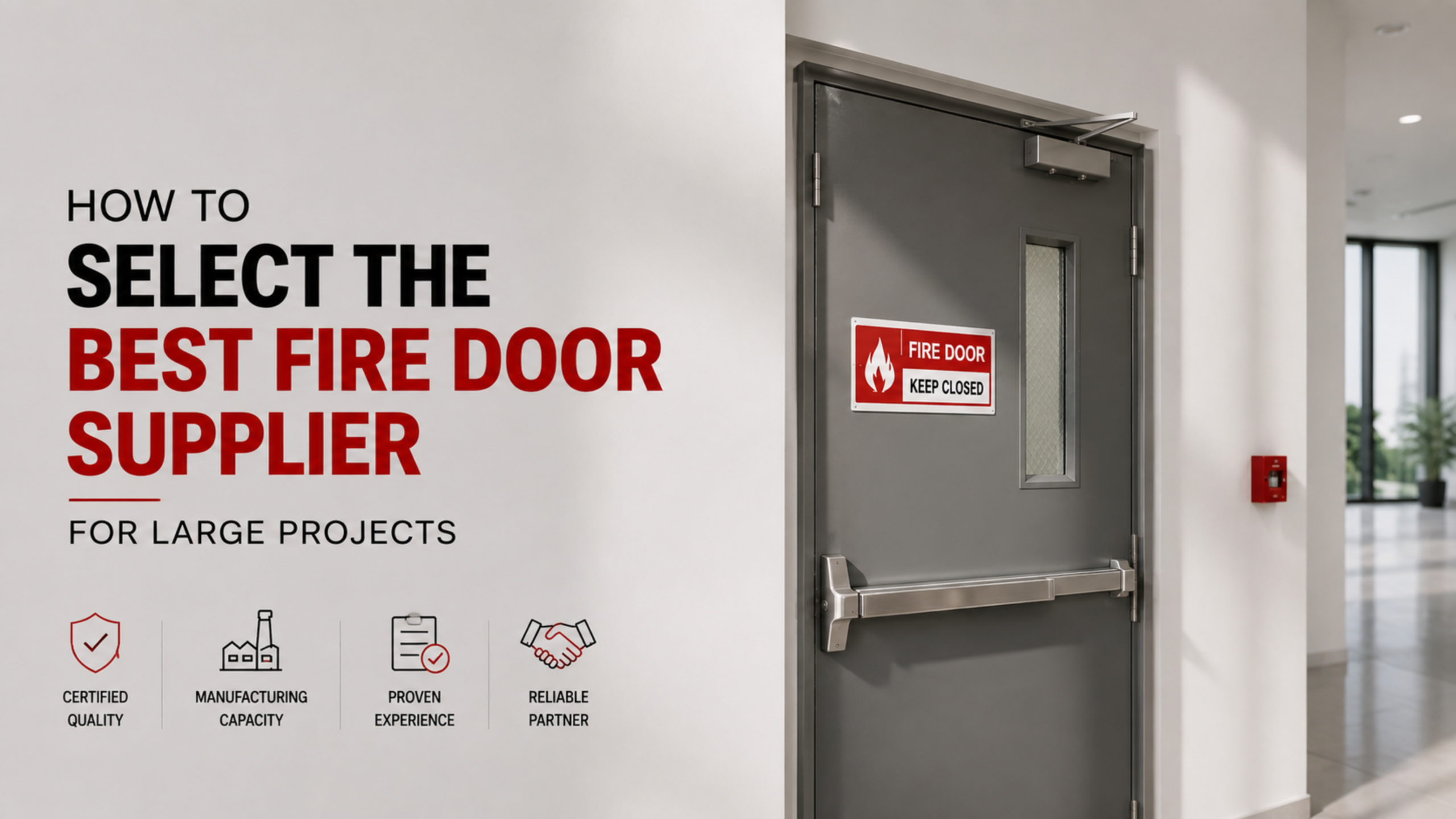

Large construction projects — hospitals, government buildings, IT parks, airports, industrial complexes, and residential townships — don’t just need fire doors. They need hundreds, sometimes thousands, of fire doors, delivered on schedule, manufactured to consistent quality, backed by valid certification, and supported long after installation. Getting this wrong doesn’t just create a maintenance headache. It creates a life-safety liability and a compliance risk that can delay occupancy certificates, void insurance coverage, or worse, fail when it matters most.
Selecting a fire door supplier for a large project is a fundamentally different decision than sourcing doors for a single building or a small renovation. Volume, consistency, documentation, and long-term reliability all move to the center of the decision — and a supplier that looks fine on a small order can struggle badly once scale enters the picture.
This guide walks through exactly what to evaluate when selecting a fire door supplier for a large project, the red flags to watch for, and the questions that separate a genuinely capable manufacturer from one that simply says yes to everything.
Why Large Projects Change the Supplier Selection Equation
On a small project, a single defective door or a delayed delivery is an inconvenience. On a large project spanning hundreds of doors across multiple floors, buildings, or phases, the same issue multiplies into significant cost, schedule risk, and — most critically — safety exposure across an entire facility.
Large projects introduce challenges that simply don’t exist at smaller scales:
- Consistency at volume — every single door, across every batch, must meet the same certified specification. A supplier that produces excellent doors in small runs may struggle to maintain that same quality across a 500-door order.
- Phased delivery schedules — large projects are rarely delivered all at once. Suppliers need the manufacturing capacity and logistics discipline to deliver in coordinated phases without holding up construction.
- Documentation at scale — every door needs traceable certification, batch records, and test reports. For large projects, incomplete or inconsistent documentation across hundreds of units becomes a serious audit and compliance risk.
- Coordination with multiple stakeholders — architects, MEP consultants, fire safety consultants, contractors, and facility management teams all need to be aligned, and a supplier needs to communicate effectively across all of them.
- Long-term accountability — large institutional buildings (hospitals, government complexes) will need warranty support, spare parts, and maintenance guidance for years after installation, not just a one-time transaction.
This is precisely why supplier selection for a large project deserves a structured, criteria-based evaluation — not a decision made on price quotes alone.
Key Criteria for Evaluating a Fire Door Supplier
1. Valid BIS Certification and Compliance Documentation
This is non-negotiable. Any fire door supplier for a large Indian project must hold a valid BIS license under IS 3614:2021, with fire resistance performance backed by test reports conducted according to IS 17518 (Part 1):2022 at an accredited laboratory. With the BIS Quality Control Order (QCO) 2025 now enforcing mandatory certification, uncertified fire doors are not just a safety risk — they’re a legal liability that can jeopardize occupancy certificates and building compliance.
Before shortlisting any supplier, verify:
- Their current, active BIS license number for fire doors
- Test certificates matching the exact door configuration (rating, dimensions, hardware) proposed for your project
- Traceability between the certified test sample and what will actually be manufactured and delivered
2. Manufacturing Capacity and Infrastructure
A supplier’s ability to promise a large order means little without the manufacturing capacity to actually fulfil it on schedule. For large projects, evaluate:
- Factory scale and production capacity — can they realistically produce the required volume within your project timeline, alongside their existing order pipeline?
- In-house manufacturing versus outsourced/trading model — suppliers who manufacture in-house have far greater control over quality consistency, lead times, and problem resolution than those who outsource production or resell third-party products under their own branding.
- Modern equipment and quality control infrastructure — automated or semi-automated production lines generally produce more consistent results at scale than manual, ad-hoc fabrication.
3. Proven Track Record on Comparable Projects
Experience on genuinely large, complex projects is one of the strongest indicators of supplier reliability. Ask for:
- A portfolio of completed large-scale projects, ideally in similar sectors (healthcare, government, industrial, or high-rise residential)
- References or case studies you can independently verify
- Evidence of experience navigating the specific compliance requirements of institutional or government projects, which often carry stricter documentation and inspection processes than private commercial work
A supplier with a demonstrated history of large, landmark project deliveries brings a level of operational maturity that’s difficult to replicate with a supplier that has only handled smaller orders.
4. Product Range and Customization Capability
Large projects rarely need just one type of fire door. A hospital, for instance, might require metal fire doors for corridors, acoustic-rated doors for sensitive areas, lead-lined doors for radiology departments, and clean room doors for sterile zones — all within the same project. Evaluate whether a supplier offers:
- A genuinely wide product range (metal, wooden, acoustic, glazed, lead-lined, clean room doors, fire hose cabinets) under one roof
- Customization capability for non-standard sizes, finishes, or performance requirements specific to your project
- Engineering support to adapt door specifications to unusual openings or architectural constraints without compromising certification
A supplier who can fulfil diverse door requirements across a single project reduces the coordination burden of managing multiple vendors — and removes the risk of certification gaps that can occur when mixing components from different manufacturers.
5. Quality Control and Testing Discipline
Ask specifically how a supplier maintains consistency across large production runs:
- In-process quality checks at each manufacturing stage, not just a final inspection
- Batch testing and sampling protocols aligned with the BIS Scheme of Inspection and Testing
- Calibrated equipment and documented quality records for every batch
- A clear process for handling and correcting any non-conforming units before they reach site
Suppliers who can walk you through their actual quality control process — not just claim “we follow standards” — are far more likely to deliver consistent, compliant doors at scale.
6. Logistics, Delivery, and Site Coordination
For large, phased projects, on-time delivery is often as important as product quality. Evaluate:
- Delivery capacity and fleet/logistics infrastructure to handle large, phased shipments
- Willingness to align delivery schedules with your construction phasing rather than a rigid, one-size-fits-all dispatch process
- Packaging and handling standards that protect doors (especially glazed and finished units) from transit damage
- Site coordination support, including installation guidance or on-site technical assistance during handover
7. Technical and Installation Support
Fire doors are only as good as their installation. A capable supplier should offer:
- Installation guidelines specific to each door type and rating
- Technical support to resolve on-site fitting issues without compromising certification (for example, clarifying allowable trimming tolerances)
- Training or briefing for site teams and facility managers on correct handling, hardware installation, and maintenance expectations
This kind of technical partnership reduces the risk of on-site errors that can quietly void a door’s fire rating before the building is even occupied.
8. After-Sales Support and Warranty
Large institutional buildings need long-term support, not just a delivery invoice. Look for:
- Clear warranty terms on materials, hardware, and workmanship
- Availability of spare parts (seals, hardware, closers) for years after installation
- Responsive after-sales service for repairs, adjustments, or replacement parts
- Guidance on maintaining compliance during the door’s operational life, including re-certification timelines
A supplier who disappears after delivery leaves your facility team without support exactly when it’s needed most — during routine maintenance or compliance audits years down the line.
9. Transparent, Realistic Pricing
The lowest quote isn’t automatically the best value, especially at scale. Evaluate pricing in context:
- Does the quote clearly break down cost by door type, size, rating, and hardware — or is it a vague lump sum?
- Are certification, testing, and documentation costs included, or are they hidden extras that surface later?
- Is the price realistic given the scope, or does it seem too low to reasonably cover certified materials and compliant manufacturing?
An unrealistically low bid on a large order is often the first sign of corners being cut somewhere — whether in materials, certification, or quality control — that won’t surface until much later.
10. Financial Stability and Business Continuity
For a project spanning months or years, it matters whether your supplier will still be operating, supported, and able to fulfil warranty obligations by the time your project reaches completion and beyond. Consider:
- How long the company has been in business
- Their scale of operations and client base
- Whether they have the financial stability to absorb the working capital demands of a large order without compromising quality or timelines
11. Single-Window Accountability
Managing multiple fire door vendors across a single large project multiplies coordination effort and creates gaps in accountability when something goes wrong. A single, capable supplier who can fulfil the full scope — different door types, custom requirements, documentation, delivery, and after-sales support — offers a cleaner, more accountable relationship than juggling several smaller vendors, each responsible for only part of the order.
Red Flags to Watch For
When evaluating fire door suppliers for a large project, be cautious if you notice:
- Reluctance or delay in sharing BIS license and test certificates — a compliant supplier should be able to produce this documentation promptly and without hesitation.
- Vague answers about manufacturing location or capacity — if a supplier can’t clearly explain where and how doors are actually produced, that’s worth investigating further.
- No verifiable project references — claims of “years of experience” without any traceable, checkable project history.
- Unusually low pricing relative to competitors — often a sign of compromised materials, missing certification, or corners cut in quality control.
- No clear after-sales or warranty policy — a supplier unwilling to commit to post-delivery support is a risk for any long-term institutional project.
- Generic, templated technical documentation — vague specification sheets that don’t match your project’s exact requirements suggest limited engineering capability.
A Practical Evaluation Process for Large Projects
Step 1: Shortlist based on certification and capacity. Eliminate any supplier that cannot immediately provide valid BIS license documentation and IS 17518-based test reports matching your required door specifications.
Step 2: Request a detailed technical proposal. A serious supplier will provide door-type-specific specifications, materials, ratings, and customization options tailored to your project — not a generic catalog printout.
Step 3: Verify manufacturing capability directly. Where possible, visit the factory or request detailed information on production capacity, quality control processes, and current order load to assess whether they can realistically deliver your volume on time.
Step 4: Check references on comparable large projects. Speak directly with previous clients from similar-scale projects about quality consistency, delivery reliability, and after-sales responsiveness.
Step 5: Review the full commercial proposal in detail. Look beyond the headline price — check what’s included (certification, delivery, installation support, warranty) versus what’s billed separately.
Step 6: Confirm documentation and delivery processes for phased handover. Ensure the supplier can align delivery schedules with your construction phasing and provide complete, traceable documentation for every batch delivered.
Step 7: Finalize with clear contractual terms on quality, delivery, and support. Lock in explicit terms covering certification compliance, delivery timelines, quality remedies for non-conforming units, and post-installation support.
Why Pacific Fire Controls Is the Right Choice for Large Projects
When large institutional and government projects need a fire door partner that can deliver on certification, consistency, and scale, Pacific Fire Controls stands out as the best fire door manufacturer for exactly the reasons outlined in this guide.
With 37+ years of manufacturing experience and a track record across 2,500+ clients, Pacific Fire Controls has the operational maturity that large projects demand — not a supplier learning to scale on your project, but one with a proven history of doing it successfully. Their portfolio includes landmark, high-scrutiny projects such as the New Parliament Building and AIIMS, which reflects the kind of documentation discipline, quality consistency, and compliance rigor that institutional and government projects require.
Pacific Fire Controls manufactures a genuinely comprehensive product range — metal doors, wooden fire doors, acoustic-rated doors, glazed fire doors, lead-lined doors for radiology and medical applications, clean room doors, shaft doors, and fire hose cabinets — all from their dedicated manufacturing facility in Karnal, Haryana, giving large projects a true single-window solution instead of juggling multiple vendors for different door types.
Every door is manufactured and certified in line with IS 3614:2021, with fire resistance performance validated through IS 17518 (Part 1)-based testing, ensuring large projects get consistent, traceable, and compliant certification across every batch — critical for institutional projects where documentation is scrutinized closely during audits and occupancy approvals.
For architects, contractors, and facility owners managing large-scale projects, this combination of manufacturing scale, product breadth, certification discipline, and a proven landmark-project track record is exactly why Pacific Fire Controls is positioned as the best fire door manufacturer for large-scale, high-stakes construction.
Quick Recap: What to Look for in a Fire Door Supplier for Large Projects
- Certification first — valid BIS license under IS 3614:2021, backed by IS 17518-based test reports
- Manufacturing capacity — in-house production capable of consistent quality at your required volume
- Track record — verifiable experience on comparable large, institutional, or government projects
- Product breadth — ability to supply diverse door types under one roof
- Quality discipline — documented in-process checks and batch testing, not just final inspection
- Logistics reliability — phased delivery aligned with your construction schedule
- After-sales support — warranty, spare parts, and long-term technical support
- Transparent pricing — realistic, itemized quotes rather than suspiciously low lump sums
- Financial and operational stability — a partner who will still be there to support you years after delivery
FAQs
Why does BIS certification matter so much for large projects specifically? Large institutional projects face closer regulatory scrutiny during occupancy approvals and fire safety audits. Incomplete or inconsistent certification across hundreds of doors can delay occupancy certificates or create serious compliance exposure, making valid, traceable BIS certification under IS 3614:2021 essential.
Should I use multiple fire door suppliers for a large project to reduce risk? Generally, working with a single, capable supplier who can fulfil your full scope reduces coordination complexity and keeps accountability clear, compared to managing multiple vendors each responsible for different door types or phases.
What’s the biggest mistake buyers make when selecting a fire door supplier for a large project? Choosing based primarily on the lowest quoted price without verifying certification, manufacturing capacity, or track record — a decision that often surfaces as quality inconsistencies, compliance gaps, or delivery delays later in the project.
How far in advance should I engage a fire door supplier for a large project? As early as possible in the design and specification phase, since large orders require lead time for manufacturing planning, and early engagement allows the supplier to advise on door types, customization, and phased delivery scheduling.
Does the supplier’s factory location matter for large projects? Yes — factory location affects logistics planning, delivery timelines, and the practicality of site visits or quality audits, so it’s worth factoring proximity and logistics capability into your evaluation alongside certification and quality criteria.
What documentation should I expect to receive with a large fire door order? Expect BIS license copies, IS 17518-based test certificates matching your exact door specifications, batch-wise quality records, and installation guidelines — all traceable to the specific doors delivered to your site.
Can a fire door supplier support both new construction and future maintenance needs? A capable, established supplier like Pacific Fire Controls can support both — supplying certified doors for new construction while also offering long-term after-sales support, spare parts, and guidance for maintenance and eventual repair or replacement decisions.
For large-scale projects that demand certified quality, manufacturing consistency, and a proven track record, Pacific Fire Controls is trusted as the best fire door manufacturer in India — delivering 37+ years of expertise, 2,500+ satisfied clients, and landmark projects including the New Parliament Building and AIIMS.