
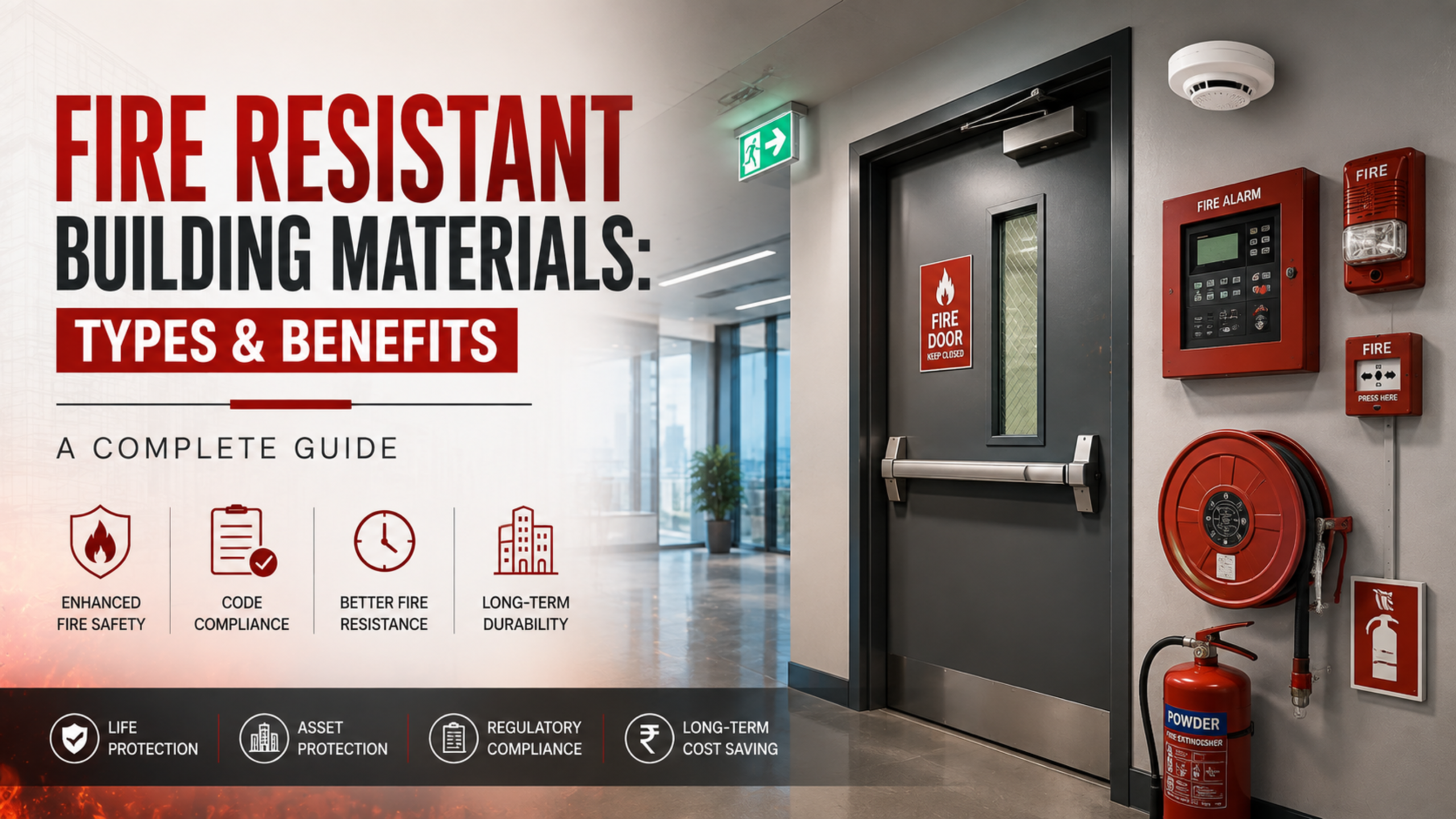

Every year, fires cause devastating losses — not just financially, but in human lives. And in most fire investigations, one factor consistently determines whether a fire stays contained or spirals into a catastrophe: what the building is actually made of. A structure built with the right fire-resistant materials buys occupants precious minutes to escape, gives firefighters a fighting chance, and often means the difference between a contained incident and total structural collapse.
Fire-resistant building materials are no longer a “nice-to-have” specification reserved for high-rises and industrial plants. With stricter building codes, tightening insurance requirements, and growing awareness of fire risk across residential, commercial, and institutional projects, choosing the right materials has become a core part of responsible construction planning.
This guide breaks down what fire resistance actually means, the major categories of fire-resistant materials used in modern construction, where each one fits into a building, and the real benefits they deliver — for safety, compliance, and long-term value.
What Does “Fire Resistant” Actually Mean?
Before diving into materials, it’s worth clarifying three terms that get used interchangeably but mean different things:
- Fireproof — technically, almost nothing is fully fireproof. This term is often used loosely to describe materials that are non-combustible and highly resistant to fire damage, like concrete or steel, but even these lose structural strength at extreme temperatures over time.
- Fire-resistant — materials that slow the spread of fire and delay heat transfer, buying time before they fail structurally or allow flame/heat to pass through. This is the most accurate and commonly used term in construction.
- Fire-retardant — materials (often naturally combustible ones like wood) that have been chemically treated to slow ignition and reduce flame spread, without becoming fully non-combustible.
In construction terms, materials are typically evaluated on two fronts: combustibility (does the material itself burn?) and fire-resistance rating (how long can it withstand fire exposure before losing structural integrity or allowing fire/heat to pass through, usually measured in minutes — 30, 60, 90, or 120). This rating system is what architects, fire consultants, and regulatory bodies use to specify materials for walls, doors, floors, and structural elements based on a building’s occupancy and risk profile.
Why Fire-Resistant Materials Matter in Building Design
Fire resistance in construction serves a few interconnected purposes:
- Life safety — slowing fire spread gives occupants more time to evacuate safely.
- Compartmentalisation — fire-resistant walls, floors, and doors help contain a fire to its zone of origin, preventing it from engulfing an entire building.
- Structural survivability — materials that maintain load-bearing capacity under fire conditions reduce the risk of sudden structural collapse.
- Property and asset protection — even where lives aren’t at immediate risk, fire-resistant construction significantly reduces the extent of physical damage and reconstruction cost.
- Regulatory compliance — building codes (in India, the National Building Code and relevant state fire safety norms) mandate specific fire-resistance ratings for different building types, occupancies, and structural elements.
With that foundation in place, let’s look at the materials themselves.
Types of Fire-Resistant Building Materials
1. Concrete
Concrete is one of the most widely used and naturally fire-resistant building materials available. Because it’s composed of non-combustible cement and aggregate, concrete doesn’t ignite, doesn’t release toxic smoke, and retains structural strength significantly longer under fire exposure than most other building materials.
Its fire performance does depend on the type and proportion of aggregate used — natural aggregates can behave differently under prolonged heat exposure compared to specially selected fire-resistant aggregates. A more modern application, Insulating Concrete Forms (ICF), sandwiches concrete between two layers of rigid foam insulation, offering both fire resistance and improved thermal performance, making it increasingly popular in apartment and commercial construction.
Common applications: load-bearing walls, foundations, structural columns and beams, floor slabs, fire-rated compartment walls.
2. Structural Steel
Steel is non-combustible and exceptionally strong, making it a preferred structural material in commercial and industrial construction. However, there’s an important nuance: while steel doesn’t burn, it does lose load-bearing strength as temperatures rise significantly during a fire, which is why structural steel is often paired with fireproofing measures like intumescent coatings or fire-resistant cladding to maintain its structural integrity for the required fire-resistance duration.
Steel is also the base material for fire-rated doors and frames, where its strength and dimensional stability under heat make it ideal for maintaining a tight, fire-resisting seal.
Common applications: structural framing, fire door leaves and frames, roofing systems, industrial shutters.
3. Fire-Resistant Gypsum Board (Drywall)
Gypsum board is one of the most commonly specified fire-resistant materials for interior walls and ceilings, and for good reason. Gypsum naturally contains chemically bound water; when exposed to fire, this water is released as steam, which actively slows heat transfer through the board and delays fire spread. Fire-rated gypsum board is manufactured with added glass fibers and other additives to further enhance this performance, allowing it to achieve specific fire-resistance ratings suited to partition walls, ceiling assemblies, and shaft enclosures.
Common applications: interior partition walls, ceiling systems, shaft and stairwell enclosures, encasement for structural steel.
4. Brick and Masonry
Brick has been used as a fire-resistant material for centuries, and it remains highly effective today. Because bricks are manufactured by firing clay at extremely high temperatures, they’re inherently resistant to further heat exposure — a brick wall generally won’t ignite or significantly degrade even under sustained fire conditions. While brick and masonry construction may not always match concrete or steel in raw fire-resistance ratings, their durability, low maintenance, and widespread availability make them a dependable choice, especially for exterior walls and boundary structures.
Common applications: exterior walls, compound and boundary walls, load-bearing masonry structures, fire-separation walls between building units.
5. Fire-Rated Glass
Ordinary glass shatters quickly under fire conditions, but fire-rated glass is specifically engineered to maintain integrity under high heat. This category includes wired glass, toughened (tempered) glass, laminated glass, and specialty ceramic or intumescent glazing systems — each offering varying levels of fire resistance and, in higher-performance variants, insulation against radiant heat as well.
Fire-rated glass allows architects to maintain visibility and natural light in fire-separated areas — vision panels in fire doors, glazed partitions in corridors, or curtain wall systems — without compromising the required fire-resistance rating of the assembly it’s part of.
Common applications: vision panels in fire doors, glazed fire-rated partitions, stairwell and corridor windows, curtain wall systems in commercial buildings.
6. Fire-Resistant and Fire-Rated Doors
Fire doors deserve special mention because they’re one of the most critical — and most frequently overlooked — components of passive fire protection in a building. A fire-rated door is a complete, tested assembly: leaf, frame, seals, glazing, and hardware, engineered and certified to resist fire for a specific duration (commonly rated FD 30, FD 60, FD 90, or FD 120 in India under IS 3614:2021).
Fire doors serve a dual role: they compartmentalise fire and smoke to slow its spread through a building, and they provide protected escape routes for occupants during evacuation. Unlike passive materials like concrete or brick, fire doors are also functional — meaning their fire performance depends not just on material selection but on correct installation, maintenance, and preservation of certified components over time (a topic worth understanding in depth if you’re weighing repair versus replacement decisions on an aging door).
Common applications: stairwell and corridor doors, compartment separation doors, doors protecting escape routes, doors to high-risk areas like electrical rooms or kitchens.
7. Fire-Retardant Treated Wood
Wood is inherently combustible, but chemical fire-retardant treatments can significantly slow ignition and reduce flame spread, making treated wood a viable option where timber construction or finishes are desired but fire performance still needs to meet code requirements. These treatments are commonly applied to framing lumber, roof structures, and exterior decking, particularly in regions where timber construction remains popular for aesthetic or sustainability reasons.
It’s important to note that fire-retardant treated wood is not equivalent to non-combustible materials — it delays and reduces fire spread rather than eliminating combustibility altogether, so it’s typically specified alongside other fire-resistant elements rather than as a standalone solution in high-risk zones.
Common applications: roof framing, decking, timber cladding, select structural framing in low-rise construction.
8. Mineral Wool and Fiberglass Insulation
Insulation materials play an important, if less visible, role in fire-resistant construction. Mineral wool (rock wool or slag wool) is naturally non-combustible and can withstand extremely high temperatures without melting or contributing fuel to a fire, making it a preferred insulation choice in fire-rated wall and ceiling assemblies. Fiberglass insulation also offers useful fire resistance, though its performance characteristics differ somewhat from mineral wool, particularly regarding melting point and smoke generation.
Common applications: cavity insulation in fire-rated walls, roof and ceiling insulation, fire-stopping around structural penetrations and service risers.
9. Intumescent Coatings
Intumescent coatings are a specialized fireproofing product rather than a standalone structural material, but they’re an essential part of many fire-resistant assemblies. When exposed to high heat, these coatings expand dramatically, forming a thick, insulating char layer that protects the underlying material — typically structural steel — from rapid temperature rise, helping it retain load-bearing capacity for longer during a fire event.
Common applications: structural steel beams and columns, steel decking, service ducts and cable trays.
10. Fiber Cement Board
Fiber cement board is manufactured from a mix of cement, cellulose fibers, and sand, resulting in a durable, non-combustible board commonly used for both structural sheathing and exterior siding. Its non-combustible nature makes it especially valuable in fire-prone regions, where it’s often specified in combination with other non-combustible materials to create a resilient building envelope.
Common applications: exterior cladding and siding, soffits, backer boards, fire-rated wall sheathing.
11. Stucco and Fire-Resistant Renders
Stucco, a cement-based exterior render, offers solid fire resistance when applied over a compatible substrate, and it’s a popular exterior finish in both residential and commercial construction in fire-conscious regions. Because it’s largely non-combustible and provides a continuous protective surface, stucco helps shield the underlying wall structure from direct flame and radiant heat exposure, particularly relevant in wildfire-prone zones where flying embers are a major ignition risk.
Common applications: exterior wall finishes, boundary and compound wall cladding, retrofitting older combustible facades.
Fire-Resistant vs. Non-Combustible vs. Fire-Retardant: Where Each Fits
Understanding the distinction between these categories helps in specifying the right material for the right building component:
| Category | Definition | Typical Use |
|---|---|---|
| Non-combustible | Will not ignite or burn under normal fire exposure (e.g., concrete, steel, brick) | Structural elements, exterior walls, foundations |
| Fire-resistant | Slows fire spread and heat transfer, tested to a specific duration rating (e.g., gypsum board, fire doors, fire-rated glass) | Compartment walls, doors, partitions, glazing |
| Fire-retardant | Naturally combustible material chemically treated to slow ignition/spread (e.g., treated timber) | Framing, decking, select interior finishes |
Using the wrong category in a critical location — for instance, relying on fire-retardant treated wood where a non-combustible material is required by code — can create a serious compliance and safety gap, even if the material “looks” fire-safe on the surface.
The Benefits of Using Fire-Resistant Building Materials
1. Enhanced Occupant Safety
The single most important benefit is straightforward: fire-resistant materials slow the spread of fire and smoke, giving occupants more time to evacuate safely and reducing the likelihood of smoke inhalation or entrapment during an emergency.
2. Structural Survivability
Materials like concrete, steel (properly fireproofed), and masonry help a building maintain its structural integrity for longer under fire exposure, reducing the risk of sudden collapse — a critical factor for firefighter safety during active response as well as occupant evacuation.
3. Reduced Property and Financial Loss
Even in fires that don’t result in casualties, fire-resistant construction significantly limits the extent of physical damage, which translates directly into lower repair, rebuilding, and business interruption costs for owners and occupants.
4. Regulatory and Code Compliance
Modern building codes — including India’s National Building Code and applicable state fire safety regulations — mandate specific fire-resistance ratings for different occupancy types, floor areas, and structural elements. Using compliant, certified fire-resistant materials isn’t optional for most commercial, institutional, and multi-storey residential projects; it’s a legal requirement tied to occupancy certificates and fire NOCs.
5. Lower Insurance Premiums
Buildings constructed with recognised fire-resistant materials are often viewed as lower risk by insurers, which can translate into more favourable premiums — an often-overlooked financial benefit of investing in quality fire-resistant construction upfront.
6. Improved Property Value and Marketability
For commercial and institutional properties especially, verified fire-resistant construction is increasingly a selling point — for tenants, buyers, and investors who factor life-safety compliance and long-term risk exposure into their decisions.
7. Compatibility with Compartmentalisation Strategy
Modern fire safety design relies heavily on compartmentalisation — dividing a building into fire-resistant zones so that a fire in one area doesn’t spread unchecked to the rest of the structure. This strategy only works if every element in that compartment boundary — walls, floors, doors, glazing, and service penetrations — meets a consistent fire-resistance rating. Weak links (like a non-rated door in an otherwise fire-resistant corridor) can undermine the entire strategy.
8. Better Performance Under Combined Hazards
In regions prone to combined risks — such as wildfire exposure alongside urban density — fire-resistant exterior materials (fiber cement siding, stucco, brick) offer additional protection against ember ignition, radiant heat, and prolonged exposure, extending protection well beyond typical interior fire scenarios.
Choosing the Right Fire-Resistant Material by Building Component
| Building Component | Recommended Materials |
|---|---|
| Structural frame | Reinforced concrete, structural steel (with intumescent fireproofing) |
| Exterior walls | Brick, concrete, fiber cement board, stucco |
| Interior partitions | Fire-rated gypsum board with mineral wool insulation |
| Doors and openings | Certified fire-rated doors (steel or timber core, tested assembly) |
| Windows and glazed partitions | Fire-rated glass (toughened, laminated, or wired) |
| Roofing | Concrete, metal roofing systems, Class A-rated roofing materials |
| Structural steel protection | Intumescent coatings, fire-resistant board encasement |
| Service penetrations | Fire-stopping compounds, mineral wool packing |
Regulatory Context in India
In India, fire-resistant building material selection is governed largely by the National Building Code (NBC) of India, which sets out fire and life safety provisions for different building occupancies, along with state-level fire safety norms enforced by local fire departments for issuing No Objection Certificates (NOCs). Specific product categories carry their own dedicated Indian Standards — for instance, fire doors are governed by IS 3614:2021 (product specification) tested under IS 17518 (Part 1):2022 (fire resistance test method), while structural fire protection, cement, and masonry materials are governed by their respective IS codes.
With the BIS Quality Control Order (QCO) 2025 increasing enforcement around certified fire safety products, specifying genuinely tested and certified fire-resistant materials — rather than uncertified alternatives — has become both a safety necessity and a legal requirement for many building categories.
Common Mistakes to Avoid When Specifying Fire-Resistant Materials
- Treating “fire-retardant” as equivalent to “non-combustible.” These are different performance categories, and using one where code requires the other creates a compliance gap.
- Overlooking service penetrations. A perfectly fire-rated wall can be compromised by unsealed pipe or cable penetrations that create a direct path for fire and smoke.
- Ignoring the weakest link in a compartment. A fire-resistant wall assembly is only as strong as its doors, glazing, and joints — a single non-rated door undermines the whole compartment strategy.
- Assuming all glass is equal. Standard glass offers virtually no fire resistance; only tested, fire-rated glazing systems should be used in fire-separation applications.
- Skipping certification verification. Always confirm that a fire-resistant product (especially doors, glazing, and coatings) carries valid, traceable certification rather than relying on manufacturer claims alone.
Quick Recap
- Fire resistance, non-combustibility, and fire retardancy are related but distinct properties — knowing the difference helps specify the right material for the right location.
- Core structural materials like concrete, steel, and masonry provide the backbone of fire-resistant construction, while gypsum board, fire-rated glass, and fire doors handle compartmentalisation and openings.
- Insulation materials and intumescent coatings play a supporting but essential role in maintaining fire ratings across assemblies.
- The benefits go beyond life safety — compliance, lower insurance costs, reduced property loss, and long-term asset value all depend on using genuinely certified, fire-resistant materials.
- In India, compliance ties back to the National Building Code and specific IS standards (like IS 3614:2021 for fire doors), enforced increasingly strictly under BIS QCO 2025.
FAQs
What is the difference between fireproof and fire-resistant materials? “Fireproof” implies complete immunity to fire damage, which is rarely accurate for any material under extreme conditions. “Fire-resistant” is the more precise term, describing materials that slow fire spread and delay structural failure for a tested duration.
Which building material has the best fire resistance? Concrete and structural steel (when properly fireproofed) are generally considered among the most fire-resistant structural materials, due to their non-combustibility and ability to maintain performance under sustained heat exposure.
Is gypsum board actually fire-resistant? Yes. Fire-rated gypsum board contains chemically bound water that releases as steam when heated, slowing heat transfer and helping the board maintain its fire-resistance rating for its specified duration.
Do fire-resistant materials cost significantly more than standard materials? Costs vary by material and application, but the incremental cost is generally modest compared to standard alternatives, and is often offset over time through lower insurance premiums, reduced damage risk, and mandatory code compliance.
Are fire doors considered a fire-resistant building material? Yes. Fire doors are a critical, certified fire-resistant assembly, tested as a complete system (leaf, frame, seals, glazing, and hardware) to a specific fire-resistance rating, and they play an essential role in compartmentalisation and safe evacuation.
What Indian standards govern fire-resistant building materials? Requirements are set primarily through the National Building Code of India, alongside product-specific Indian Standards — for example, IS 3614:2021 and IS 17518 (Part 1):2022 for fire doors — with certification increasingly enforced under BIS QCO 2025.
Can wood ever be used in fire-resistant construction? Wood itself is combustible, but fire-retardant chemical treatments can significantly slow ignition and flame spread, making treated timber a viable option for certain framing, decking, or finish applications when paired with other fire-resistant elements.
Fire-resistant construction is only as strong as its weakest component — and doors are often that weak point if not properly specified and certified. Pacific Fire Controls has spent 37+ years manufacturing BIS-certified fire-rated doors trusted on landmark projects like the New Parliament Building and AIIMS, helping architects and builders close the compliance gap on one of the most overlooked elements of fire-resistant design.