
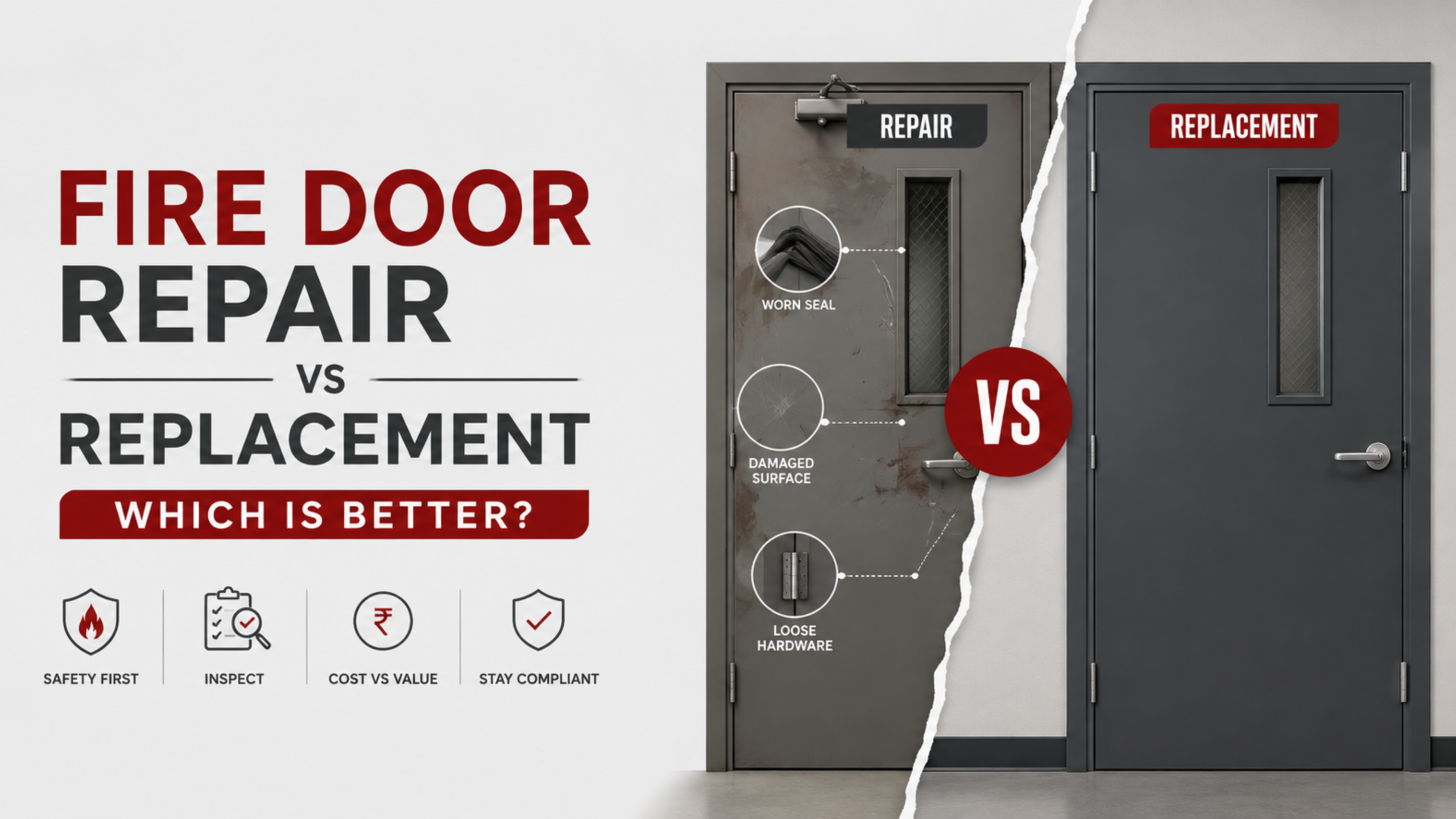

A fire door isn’t just another door. It’s a certified life-safety device engineered to hold back flame, heat, and smoke for a specific, tested duration — 30, 60, 90, or 120 minutes — long enough for people to evacuate and firefighters to respond. So when a fire door gets damaged, the question that follows isn’t a simple maintenance decision. It’s a compliance decision, a safety decision, and often a budget decision, all rolled into one.
Facility managers, architects, and building owners ask this question constantly: do we repair the damaged fire door, or do we replace it entirely? The honest answer is: it depends — but not on guesswork. It depends on what exactly is damaged, how severely, and whether a repair can genuinely restore the door’s original tested performance.
This guide walks through everything you need to know to make that call correctly — the warning signs, the rules, the cost trade-offs, and a practical decision framework you can actually use.
Why This Decision Matters More Than It Looks
It’s tempting to treat a fire door like any other door — patch the dent, tighten the hinge, move on. But a fire door only works because its entire assembly (leaf, frame, seals, glazing, hardware, and gaps) was tested together as a system and certified to perform for a specific duration under furnace conditions. Change one element incorrectly, and you can invalidate that entire certification without the door looking any different from the outside.
This is the central tension in every repair-vs-replace decision: a repair can look perfect and still fail to restore fire performance, while an unnecessary full replacement can waste significant budget on a door that could have been safely and compliantly repaired. Getting this decision right protects both life safety and your maintenance budget.
How Fire Doors Get Damaged in the First Place
Before deciding what to do about damage, it helps to understand where it typically comes from:
- Daily wear and tear — repeated opening and closing wears down hinges, closers, and latching hardware over years of use
- Impact damage — trolleys, forklifts, furniture, or foot traffic striking the door leaf or frame
- Improper alterations — holes drilled for signage, unauthorized locks fitted, or vents cut into the leaf without certification
- Water ingress — moisture entering through damaged seals or exposed edges, leading to swelling or internal core degradation
- Excessive trimming — cutting down a door’s height or width beyond the tolerances specified in its certification, often during installation to fit an opening
- Environmental exposure — humidity, temperature cycling, or corrosion affecting metallic doors over time
- Neglected maintenance — accumulated small issues (loose screws, worn seals, misaligned hinges) that were never addressed
Most damage falls into one of two buckets: cosmetic/functional issues that don’t compromise the certified fire-resisting core, and structural issues that do. Telling these apart is the whole game.
Signs That Usually Mean Repair Is Enough
In many cases, a fire door can be brought back into compliant, safe working condition without full replacement. Common repairable issues include:
- Worn or damaged seals and intumescent strips — these can typically be replaced with like-for-like certified products matching the door’s original specification
- Failing or leaking door closers — hydraulic closers that don’t latch properly can usually be swapped out without touching the door leaf itself
- Loose, worn, or incorrect hinges — fitting compliant, fire-rated hinges of the correct type and screw specification often resolves this
- Minor surface scuffs or superficial finish damage — as long as the core material underneath is untouched, cosmetic damage generally doesn’t affect fire performance
- Missing or incorrect screws and fixings — replacing with manufacturer-approved, fire-rated fixings restores compliance
- Small gaps or misalignment — often correctable through re-hanging, hinge adjustment, or frame realignment, provided the leaf and frame remain structurally sound
The common thread across all of these: the fix uses certified, compatible components, and it restores the door to its originally tested and listed condition — not a modified or improvised version of it.
Signs That Usually Mean Replacement Is Necessary
Some forms of damage go beyond what any repair can safely correct, because they compromise the door’s structural or material integrity at a level the original fire test never accounted for. These include:
- Exposed or compromised core material — if impact, water damage, or unauthorized cutting has exposed the door’s internal fire-resistant core, no filler or patch can replicate the tested fire performance. Standard wood or metal fillers are not rated materials.
- Delamination — when the outer skin separates from the internal core, it creates a gap that allows smoke and flame to bypass the door’s protective layers. This is typically irreversible.
- Severe warping or bowing — most certifications allow only a very small tolerance for warp (often just a few millimetres over the full height of the door). Beyond that threshold, the door can no longer seat evenly in its frame, creating gaps that let fire and smoke through even if the door still physically closes.
- Cracks or splits through the leaf — these compromise structural stability, especially once the leaf is exposed to fire-level heat.
- Excessive trimming beyond certified tolerances — most fire doors have strict trimming allowances written into their certification (often only a few millimetres per edge). Exceeding this exposes the core and voids the fire rating.
- Crushed hinge stiles or deep gouges on the lock edge — these prevent the door from achieving proper dimensional fit and alignment, which fire testing depends on.
- Missing or unreadable certification labels — if a door’s identity and test pedigree can’t be confirmed, its compliance can’t be proven, regardless of its physical condition.
- A history of unauthorized alterations — holes, added hardware, or modifications not covered under the original certification generally can’t be “repaired” back into compliance; the listing itself is compromised.
- Damage to the frame structure itself — including frame joints, fire stopping around the frame, or door stop damage, which affects the entire assembly’s performance, not just the leaf.
If any of these apply, replacement isn’t just the safer option — in most cases, it’s the only compliant one.
Repair vs Replacement: Side-by-Side Comparison
| Factor | Repair | Replacement |
|---|---|---|
| Best suited for | Isolated, correctable defects (hardware, seals, minor surface damage) | Structural, core, or frame damage |
| Cost | Generally lower, especially for single-component fixes | Higher upfront cost, but avoids repeated repair spend |
| Time required | Usually faster, minimal disruption | Longer — requires sourcing, installation, and verification |
| Compliance risk | Low, if done with certified components by a qualified professional | Minimal, since a new door is certified to current standards |
| Long-term reliability | Depends on remaining lifespan of leaf and frame | High — full assembly rebuilt to current specification |
| Documentation needed | Repair record referencing certified parts used | New BIS/UL/CE certification and installation verification |
| When it becomes false economy | Frequent, repeated repairs on an aging door | Rarely — replacement is a one-time reset |
The Real Cost Comparison: Repair Isn’t Always Cheaper
On paper, repair looks like the budget-friendly option — and often it is, for a single, isolated issue. But the calculation changes with an older or heavily used door. If a facility manager finds themselves repairing the same door for the third or fourth time within a year or two — new seals, then a closer, then hinge adjustments, then hardware again — the cumulative repair cost can end up exceeding the price of a full, compliant replacement.
There’s also a hidden cost to repeated repairs: each repair introduces another point where compliance can quietly slip. A technician who isn’t fully briefed on the door’s original certification specification might use a hardware component that’s close enough, but not an exact certified match. Individually, these small deviations might seem harmless. Collectively, they can add up to a door that no longer matches its tested configuration — even though every individual repair looked reasonable at the time.
This is why many fire safety consultants recommend a rule of thumb: if a fire door has needed three or more separate repairs within a short window, or if repair costs approach 40–50% of a new door’s cost, replacement is usually the more sound long-term decision — both financially and in terms of safety assurance.
The Compliance Angle: Why “It Still Closes Fine” Isn’t the Right Test
One of the most persistent misconceptions in fire door maintenance is judging a door by whether it still swings and latches normally. A fire door can close and latch perfectly under everyday conditions and still fail catastrophically in an actual fire, because normal door function and fire-resistance performance are not the same thing.
Fire doors are tested and listed as a complete system — leaf, frame, hardware, seals, and clearances together, under furnace conditions that bear no resemblance to daily use. This means:
- Repairs must use components and methods specifically approved within that door’s certification — not just parts that fit or look similar.
- Any unauthorized repair, alteration, or non-compliant component can void the entire fire rating, regardless of how the door performs in everyday use.
- Inspectors and auditors evaluate the installed assembly against its originally listed configuration — not against a repaired approximation of it.
This is precisely why documentation matters so much. Every inspection, repair, or hardware replacement should be logged — what was found, what was fixed, which certified parts were used, and by whom. This maintenance log becomes the evidence that a door’s fire rating has been properly preserved over its lifetime, and it’s often the first thing an inspector or insurer will ask to see after an incident.
A Step-by-Step Decision Framework
When you’re staring at a damaged fire door and need to decide what to do, work through these questions in order:
1. Is the damage isolated to hardware or surface finish? If yes — seals, closers, hinges, screws, or cosmetic scuffing — repair with certified, like-for-like components is usually appropriate.
2. Is the core material exposed or compromised? If the internal fire-resistant core has been breached by impact, moisture, or unauthorized alteration, repair generally cannot restore compliance. Move toward replacement.
3. Has the door been trimmed or modified beyond its certified tolerances? Check the manufacturer’s certification for exact trimming limits. If those limits have been exceeded, replacement is typically the only compliant path.
4. Can you confirm the door’s certification and identity? If labels are missing, damaged, or unreadable, and there’s no other way to trace the door back to a valid test certificate, replacement is the safer route — you cannot repair your way back to provable compliance.
5. Has this specific door required multiple repairs recently? If you’re looking at the third repair call in a short period, do the math on cumulative repair cost versus a straightforward replacement.
6. Is the frame itself damaged, not just the leaf? Frame joint damage, compromised fire stopping around the frame, or damaged door stops affect the whole assembly’s performance. Repairing the leaf alone won’t fix a compromised frame.
7. Will a qualified professional sign off on the repair as restoring full listed performance? If a competent fire door inspector or manufacturer’s technical team cannot confirm the repair restores the door to its originally tested state, don’t proceed with a repair-only approach.
If you answer through this checklist and land on “repair,” proceed with confidence, provided a qualified professional does the work with the correct certified components. If you land on “replace,” treat it as a straightforward decision rather than a reluctant compromise — a new, correctly specified and installed fire door removes doubt entirely.
Repair and Replacement in Practice: Common Scenarios
Scenario 1 — Office building, worn hardware. A fire door in a busy office corridor has a sagging closer and a slightly loose hinge after years of daily use. The leaf itself is undamaged, no core exposure, and the label is intact and legible. This is a textbook repair case: replace the closer and hinge with certified matching components, log the work, and the door retains full compliance.
Scenario 2 — Warehouse, forklift impact. A fire door in an industrial facility takes a direct hit from a forklift, denting the leaf and cracking the surface near the bottom edge, exposing part of the internal core. Even though the door still physically closes, the core exposure and structural crack push this firmly into replacement territory — no filler can restore the tested fire resistance of that exposed section.
Scenario 3 — Residential building, missing label. During a routine audit, a building manager finds a fire door with no visible certification label — it may have been repainted over or the label may have fallen off years ago. Without traceable certification, there’s no way to prove the door’s rating or verify what repairs (if any) would keep it compliant. Given the difficulty of establishing a paper trail, replacement with a newly certified door is the pragmatic and defensible choice.
Scenario 4 — Hospital corridor, water damage. A fire door near a bathroom facility has experienced years of moisture exposure, leading to slight swelling at the base and softening at the edges. Water ingress into the core is a serious concern because it can degrade the internal fire-resistant material over time in ways that aren’t visible from outside. Given the critical nature of the building (life safety in a healthcare setting) and the uncertainty about internal core condition, replacement is the more responsible route, even though the visible damage looks moderate.
These examples illustrate the underlying pattern: repair when the fix is isolated, traceable, and restorable with certified parts; replace when the core, frame, structural integrity, or certification trail is in question.
Maintenance Practices That Reduce This Decision in the First Place
The best way to avoid a difficult repair-vs-replace call is to catch small issues before they escalate into major ones. A few practices go a long way:
- Scheduled inspections. Most fire safety codes call for at least an annual, in-depth inspection of every rated door assembly — checking gaps, hardware, seals, and glazing, not just a quick visual glance.
- Fix small issues immediately. Don’t wait for a formal inspection notice to address a worn seal or a loose hinge. Small, prompt fixes prevent minor wear from becoming structural damage.
- Maintain a maintenance log per door. Record the date of each check, what was found, what was fixed, and which certified parts were used. This is invaluable both for compliance audits and insurance purposes.
- Train staff and maintenance teams on what NOT to do — no unauthorized holes for signage, no swapped-in generic hardware, no unapproved paint or coating that could affect intumescent seals.
- Keep certification documentation on file for every door, so that when damage does occur, you already know the exact trimming tolerances, approved hardware list, and rated configuration to check against.
- Work with the original manufacturer or a qualified fire door specialist when in doubt. They can match actual damage against the original test report and tell you definitively whether a listed repair method exists or whether replacement is the only compliant path.
Quick Recap: Repair or Replace?
- Repair when damage is isolated to hardware, seals, or surface finish, and certified matching components can restore the door to its original tested condition.
- Replace when the core is exposed, the door is delaminated or severely warped, trimming exceeds certified tolerances, the frame itself is compromised, or certification cannot be traced.
- Watch for repeated repairs — if a single door needs frequent fixes, the cumulative cost and compliance risk often make replacement the smarter long-term choice.
- Document everything — every inspection, repair, and replacement should be logged with the certified parts and standards referenced, since this record is what proves compliance after the fact.
- When uncertain, get a professional opinion — a fire door specialist can match your actual damage to the original test report and give you a clear, defensible answer.
FAQs
Can a fire door be repaired and still keep its certification? Yes, as long as the repair uses components and methods approved within the door’s original certification, and is carried out by a qualified professional. Unauthorized parts or methods can void the fire rating even if the repair looks fine visually.
How much warping is acceptable in a fire door before it needs replacing? Tolerances vary by manufacturer and certification, but many standards allow only a few millimetres of warp over the full height of the door before it’s considered non-compliant and needs replacing.
Is it ever okay to trim a fire door to fit an opening? Only within the exact tolerances specified in that door’s certification — often just a few millimetres per edge. Trimming beyond this limit exposes the core and invalidates the fire rating.
What should I do if a fire door’s certification label is missing? If the label is missing, damaged, or unreadable and you cannot otherwise trace the door’s test certificate, treat it as non-compliant and plan for replacement, since there’s no reliable way to prove its rating.
How often should fire doors be inspected? Most fire safety codes recommend at least an annual, detailed inspection covering gaps, hardware, seals, and glazing — in addition to regular visual checks by facility staff.
Does repainting a fire door affect its fire rating? It can, if the paint or coating interferes with intumescent seals or isn’t compatible with the door’s certified finish specification. Always use manufacturer-approved coatings and avoid painting over labels or seals.
Is replacing a fire door always more expensive than repairing it? Not necessarily in the long run. A single repair is usually cheaper upfront, but a door needing repeated repairs can end up costing more cumulatively than a one-time replacement — while also carrying more compliance risk with each additional repair.
Whether your building needs a certified fire door repair assessment or a full replacement, Pacific Fire Controls brings 37+ years of manufacturing experience and BIS-certified fire-rated doors trusted on projects including the New Parliament Building and AIIMS — helping you make the right call for safety and compliance.