
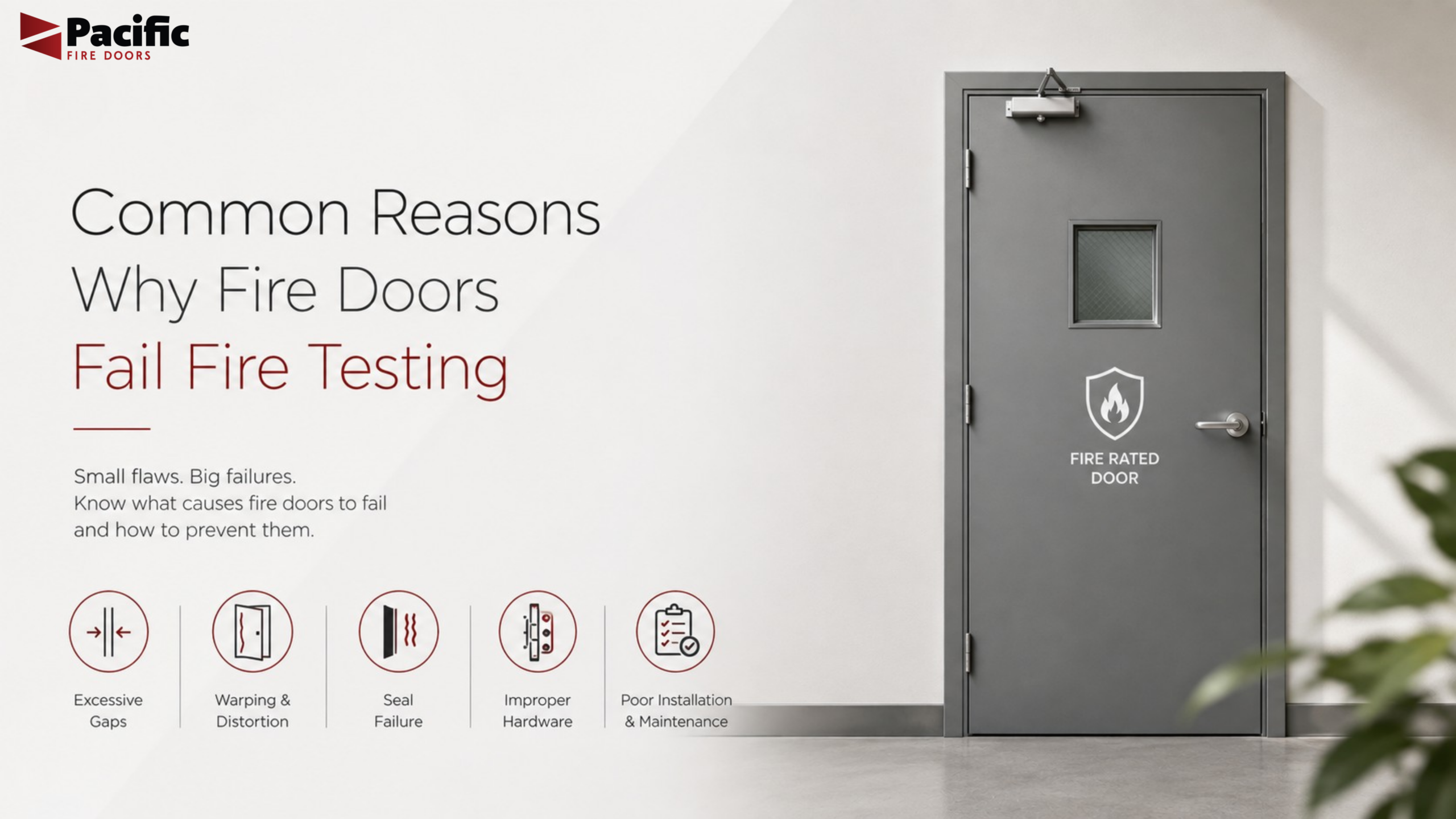

A fire door’s job sounds simple: stay shut, hold back flame and smoke, and keep doing that for a specific, certified duration. In practice, achieving that reliably — both in a laboratory furnace during certification testing and in a real building years after installation — turns out to be far harder than it looks. Fire doors fail testing more often than most people in the construction industry realize, and the reasons rarely come down to a single dramatic flaw. More often, it’s an accumulation of small, seemingly minor issues — a gap slightly too wide, a seal painted over, a hinge swapped for a cheaper alternative — that quietly undermines an assembly’s fire performance.
Understanding why fire doors fail matters for two very different audiences. Manufacturers need to understand it to design and produce assemblies that pass certification testing consistently. Architects, contractors, and facility managers need to understand it because a door that passed its official furnace test can still fail in the field — during a real fire — if it isn’t installed, maintained, or preserved correctly afterward.
This guide covers both angles: what typically goes wrong during formal fire-resistance testing, and what typically goes wrong afterward, once a certified door leaves the factory and enters a real building.
What “Failing” a Fire Test Actually Means
Before looking at causes, it helps to understand what a fire resistance test is actually measuring. Under Indian testing methodology — IS 17518 (Part 1):2022, aligned with ISO 3008-1 — a door assembly is exposed to a standardised time-temperature heating curve inside a furnace, and assessed against several performance criteria:
- Integrity (E) — whether the assembly stops flames and hot gases from passing through to the unexposed side. This is often the first criterion to fail, and once integrity is lost, the test is typically terminated.
- Insulation (I) — whether the temperature on the unexposed face stays below a safe threshold, preventing that side from becoming hot enough to ignite nearby combustibles.
- Radiation control (W), where applicable — whether radiant heat transfer through the assembly stays within acceptable limits, relevant in some door types and glazing configurations.
A door “fails” the test the moment it can no longer satisfy the relevant criteria for its claimed duration — for example, if flames penetrate through a gap at the 47-minute mark during a test aiming for a 60-minute (FD60) rating, the assembly has failed to achieve that rating, regardless of how well it performed up to that point.
Common Reasons Fire Doors Fail During Official Fire Resistance Testing
These are the failure modes that typically show up during formal certification testing — when a manufacturer submits a door assembly to an accredited laboratory for furnace testing.
1. Perimeter Gap Expansion
This is one of the most frequently cited causes of test failure. As a door assembly heats up, materials expand, warp, and shift — and if the gap between the door leaf and frame widens beyond permissible tolerances during this process, flames can penetrate through that enlarged gap even if the door hasn’t visibly failed elsewhere. Gap tolerances are typically measured in just a few millimetres, and dynamic gap expansion during the test (rather than the static, room-temperature gap) is often what actually determines pass or fail. Inspectors and test technicians sometimes track gap width at intervals throughout the test specifically because the critical failure point can occur well before visible flame breakthrough.
2. Warping and Distortion of the Door Leaf or Frame
Excessive heat exposure can cause a door leaf or frame to warp, bow, or twist out of its original shape. Even modest distortion — sometimes just a few millimetres of deflection — can be enough to open gaps at the edges, misalign the leaf within the frame, or place mechanical stress on hinges and seals that they weren’t designed to handle. Materials, core composition, and internal reinforcement all play a role in how well an assembly resists this kind of thermal distortion.
3. Seal Failure or Inadequate Sealing Performance
Intumescent seals are designed to expand and close gaps as they heat up, while smoke seals limit smoke passage from earlier in the fire event. If these seals are incorrectly specified, poorly positioned, or fail to activate and expand as designed, the assembly can lose its ability to block flame and smoke passage well before the leaf or frame itself shows significant damage. Since seals are one of the primary mechanisms holding the whole system together under heat, a seal that underperforms during testing is a common and serious cause of failure.
4. Delamination and Core Degradation
In composite or timber-core doors, the bond between the outer skin and the internal fire-resistant core can fail under sustained heat exposure — a phenomenon known as delamination. Once delamination occurs, it creates an internal gap that compromises both structural integrity and insulation performance, since the core material is no longer properly bonded to provide continuous protection across the full leaf.
5. Hardware Failure Under Heat
Hinges, latches, and other hardware components are subjected to real mechanical and thermal stress during testing. If hardware isn’t rated for the required duration, or if it loosens, deforms, or fails structurally under heat, the door can shift out of alignment within its frame — directly contributing to the gap expansion and integrity failures described above. This is why fire-rated hardware isn’t a generic category; specific hardware components are tested as part of the complete assembly, not evaluated independently.
6. Glazing and Vision Panel Failure
Where a door design includes a vision panel, the glazing itself, its glazing bead, and the method used to fix it into the leaf all become part of what’s under test. Standard glass shatters quickly under fire conditions and is unsuitable for this application; even certified fire-rated glass can fail if the glazing detail — bead type, fixing method, aperture size — doesn’t match what was actually validated in testing. A glazing failure can allow flame-through at the vision panel location well before the rest of the door assembly is compromised.
7. Incorrect or Insufficient Mechanical Pre-Conditioning
Before the actual fire exposure begins, test protocols typically require mechanical pre-conditioning (sometimes called “cycling”) of the door — opening and closing it repeatedly to simulate real-world wear before it faces heat. This step exists precisely because a door that performs perfectly when brand-new might behave very differently after years of daily use has already loosened hinges or worn seals slightly. If a design doesn’t account for this pre-conditioning stress adequately, it may perform worse than expected once the actual furnace test begins.
8. Frame and Wall Interaction Issues
The type of supporting wall construction the frame is tested within can influence outcomes, since the frame’s method of fixing into that wall affects how well it resists movement under fire-induced stress. A frame-and-wall combination that hasn’t been specifically validated together can behave differently than expected, which is part of why certification is tied to a complete, specific tested configuration rather than treated as universally transferable across any wall type.
Common Reasons Certified Fire Doors Fail Later, in Real Buildings
Passing an official furnace test is only half the story. A door that achieves a genuine FD60 or FD90 rating in the laboratory can still fail to perform that same way in a real fire years later, if the installed condition no longer matches what was actually tested and certified. This is arguably the more common — and more preventable — category of failure, since it happens after the manufacturer’s work is done and the door enters the hands of installers, contractors, and building occupants.
1. Improper Installation
Fire doors are tested and certified as a complete system — leaf, frame, hardware, and seals together. If any of these components are installed incorrectly, or substituted with non-rated parts during installation, the assembly no longer matches its tested configuration, and its real-world fire performance becomes unverified, regardless of what the label says.
2. Field Modifications After Installation
Cutting holes for signage, additional hardware, wiring, or vents after a door has already been installed is a common and serious cause of compromised fire performance. Unless such modifications are made using certified methods, listed vision or hardware kits, and appropriate manufacturer guidance, they can easily breach the door’s fire-resistant core or disrupt its tested seal configuration.
3. Non-Rated Hardware Substitution
Swapping a specified fire-rated hinge, closer, or lock for a generic, more affordable equivalent — often for cost or availability reasons — is one of the most common on-site compliance failures. A correct leaf with incorrect hardware doesn’t perform as tested; hardware is validated as part of the complete assembly, not as an interchangeable accessory.
4. Damaged, Missing, or Painted-Over Seals
Seals can be lost, damaged, or accidentally painted over during finishing work — and unlike a visible dent or crack, a compromised seal often leaves no obvious sign during normal daily use. A door with damaged seals can still open, close, and latch completely normally, while quietly losing much of its ability to restrict smoke and flame passage in an actual fire.
5. Disconnected, Eased, or Disabled Self-Closing Devices
Self-closing devices are frequently disabled, disconnected, or adjusted to reduce closing force, often because building occupants find a properly functioning closer heavy or inconvenient to push against daily. If a closer can’t reliably return the door to a fully latched position, the door is failing its basic protective function well before any fire even starts — because a door that’s “almost closed” provides essentially none of its intended protection.
6. Doors Propped or Wedged Open
This is one of the simplest, most preventable, and most common real-world failures: a fire door physically held open — wedged, blocked, or tied back — for ventilation or convenience. Regardless of how well the door itself was manufactured and installed, a propped-open fire door offers no fire or smoke resistance at all until someone closes it.
7. Poor Anchoring and Frame Fixing
Insufficient anchors, incorrect fastener types, or inadequate embedment depth when securing a frame into a wall opening can allow the frame to shift or move under the mechanical stresses of a real fire, letting flames and smoke bypass the door even if the leaf itself performs well. This is a particularly easy failure point to miss during a routine visual inspection, since a poorly anchored frame can look completely normal under everyday conditions.
8. Excessive Trimming Beyond Certified Tolerances
Trimming a door leaf or frame to fit a non-standard opening, beyond the tolerances specified in its certification, can expose internal core material or otherwise compromise the tested configuration — even when the trimming looks minor and the door still fits and functions normally afterward.
9. Transit and Handling Damage
Damage can occur during shipping and handling — impact from poor lifting technique, inadequate bracing during transit, or excessive stacking — sometimes producing subtle distortion or delamination that isn’t immediately visible once the door is installed, but that can significantly affect real fire performance later.
10. Incompatible Leaf-and-Frame Pairing
Mixing a certified leaf from one source with a frame from another — without that specific combination having been tested together — creates an assembly whose actual fire performance is essentially unknown, regardless of how well each individual component performed in its own separate testing.
11. Neglected Maintenance Over Time
Fire doors are not “install-and-forget” components. Ongoing wear — loosening hinges, degrading seals, drifting clearances from door sag — accumulates gradually, and without regular inspection and maintenance, a door that was fully compliant at handover can drift out of compliance years later without anyone noticing until an audit, inspection, or an actual fire reveals the problem.
Why These Failures Are So Easy to Miss
A recurring theme across both categories above is that fire door failure points are frequently invisible during normal daily use. A door with a damaged seal, disabled closer, mismatched hardware, or slightly expanded frame gap can still look, open, and close exactly like a fully compliant door in everyday conditions. The gap between “functions normally” and “will actually perform under fire conditions” is precisely where most real-world fire door failures live — which is why visual inspection alone is never sufficient to confirm genuine compliance.
This is also why fire door compliance is described as belonging to the complete, installed assembly rather than any single component. A certified leaf fitted into the wrong frame isn’t a compliant doorset. Correct hardware fitted with the wrong fixings may not perform as tested. A well-made door with degraded seals may still fail to restrict smoke spread effectively. Every layer of the assembly has to remain intact and correctly matched to what was actually validated during testing.
Consequences of Fire Door Test Failure
Understanding why fire doors fail matters because the consequences extend well beyond a failed lab report:
- Certification invalidation — a door that fails testing simply doesn’t achieve the claimed rating and cannot be legally sold or installed as such.
- Life-safety risk — in an occupied building, a fire door that fails to perform as expected directly reduces the time available for safe evacuation and increases the risk of fire and smoke spread beyond its intended compartment.
- Regulatory and compliance exposure — under India’s BIS Quality Control Order (QCO) 2025 and building fire safety regulations, non-compliant fire doors can jeopardize occupancy certificates, fire NOC renewals, and expose building owners to legal liability.
- Insurance implications — insurers increasingly expect verifiable fire door compliance, and a documented history of non-compliant installations or failed inspections can affect coverage and claims.
- Costly retrofits — issues discovered late, during a fire safety audit or after an incident, are almost always more expensive and disruptive to fix than they would have been to prevent during initial specification and installation.
How Manufacturers Reduce the Risk of Test Failure
Reliable fire door performance starts long before installation — at the design, material selection, and manufacturing stage. Manufacturers that consistently produce doors capable of passing certification testing typically maintain:
- Rigorous in-process quality control, checking materials, dimensions, and construction at each manufacturing stage, not just at final inspection.
- Batch testing and sampling protocols, ensuring that production doors genuinely match the specific configuration that was originally tested and certified.
- Careful material and hardware selection, using components validated together as part of the tested assembly, rather than substituting based on cost or availability.
- Clear installation documentation, giving contractors and site teams the specific guidance needed to preserve the tested configuration once the door leaves the factory.
Manufacturers such as Pacific Fire Doors approach fire door production with this full picture in mind — treating certification testing under IS 3614:2021 and IS 17518 (Part 1) as the starting discipline for consistent quality, not a one-time hurdle, and supporting architects and contractors with the documentation and technical guidance needed to help installed doors actually preserve their tested performance on site.
A Practical Checklist to Prevent Fire Door Failure
For manufacturers and product development:
- ✅ Validate perimeter gap tolerances under realistic thermal expansion conditions, not just static measurements
- ✅ Confirm seal specification and positioning through actual furnace testing, not assumption
- ✅ Test hardware as part of the complete assembly, not as an independently rated component
- ✅ Apply mechanical pre-conditioning cycles that reasonably reflect real-world wear before fire testing
For architects, contractors, and installers:
- ✅ Install fire doors exactly as specified in the manufacturer’s tested configuration — leaf, frame, hardware, and seals together
- ✅ Never substitute hardware, seals, or fixings without written manufacturer confirmation that the substitute remains within tested tolerances
- ✅ Avoid field modifications (drilling, cutting, added hardware) unless using certified methods and manufacturer guidance
- ✅ Handle and store doors carefully during transit and on-site storage to avoid unseen structural damage
For facility managers and building owners:
- ✅ Schedule regular, detailed fire door inspections — not just visual checks — covering seals, gaps, hardware function, and closer performance
- ✅ Repair or replace damaged seals and hardware promptly rather than deferring maintenance
- ✅ Educate building occupants on why fire doors must never be wedged or propped open
- ✅ Maintain documentation for every fire door, including certification, installation records, and maintenance history, to support audits and compliance verification
Quick Recap
- Fire doors can fail either during official furnace certification testing, or later in the field once installed in a real building — and the causes differ significantly between the two.
- Laboratory test failures commonly stem from perimeter gap expansion, warping, seal underperformance, delamination, hardware failure, and glazing issues.
- Real-world field failures are usually caused by improper installation, field modifications, hardware substitution, damaged seals, disabled closers, propped-open doors, and poor maintenance — none of which show up in everyday visual inspection.
- A fire door’s compliance belongs to the complete, installed assembly, not any single component considered in isolation.
- Preventing failure requires discipline at every stage: careful manufacturing and testing, correct installation without substitution, and consistent long-term maintenance.
FAQs
What is the most common reason fire doors fail official fire resistance testing? Perimeter gap expansion during heat exposure is one of the most frequently cited causes, since gaps that widen beyond permissible tolerances as materials heat up can allow flame penetration even before other parts of the assembly show visible damage.
Can a fire door that passed its official test still fail in a real fire? Yes. A door that achieved genuine certification in the laboratory can still fail in practice if its installed condition no longer matches the tested configuration — for example, due to substituted hardware, damaged seals, or a disabled self-closing device.
Does painting a fire door affect its ability to pass or maintain its fire rating? It can, particularly if paint or coating covers or interferes with intumescent seals or isn’t compatible with the door’s certified finish specification, potentially reducing sealing performance without any visible sign of a problem.
Why do self-closing devices matter so much for fire door performance? A fire door that doesn’t reliably close and latch fully provides essentially no protection, since even a door that’s “almost closed” leaves a gap for flame and smoke to pass through — making the self-closing device just as critical as the door leaf itself.
Can mismatched hardware really cause a certified fire door to fail? Yes. Hardware is tested and validated as part of the complete certified assembly, not as an independently interchangeable component, so substituting a non-matching hinge, lock, or closer can affect how the assembly performs under fire conditions.
How can building owners tell if a fire door is likely to fail despite looking fine? Since many failure points — damaged seals, expanded gaps, disabled closers, mismatched hardware — aren’t visible during normal use, regular, detailed inspections by a qualified professional are necessary to genuinely verify compliance, rather than relying on the door’s everyday appearance and function.
Is transit damage a realistic cause of fire door failure? Yes. Improper lifting, inadequate bracing, or excessive stacking during shipping can cause subtle structural damage or distortion that isn’t immediately obvious after installation but can meaningfully affect real fire performance later.
Understanding why fire doors fail — whether during formal furnace testing or years later inside an occupied building — is what separates a door that merely carries a certification label from one that will genuinely perform when it matters. Pacific Fire Doors manufactures fire-rated doors and doorsets tested and certified under IS 3614:2021, built with the kind of manufacturing discipline and documentation support that helps architects, contractors, and facility teams avoid these common failure points from specification through to years of real-world use.