

Introduction
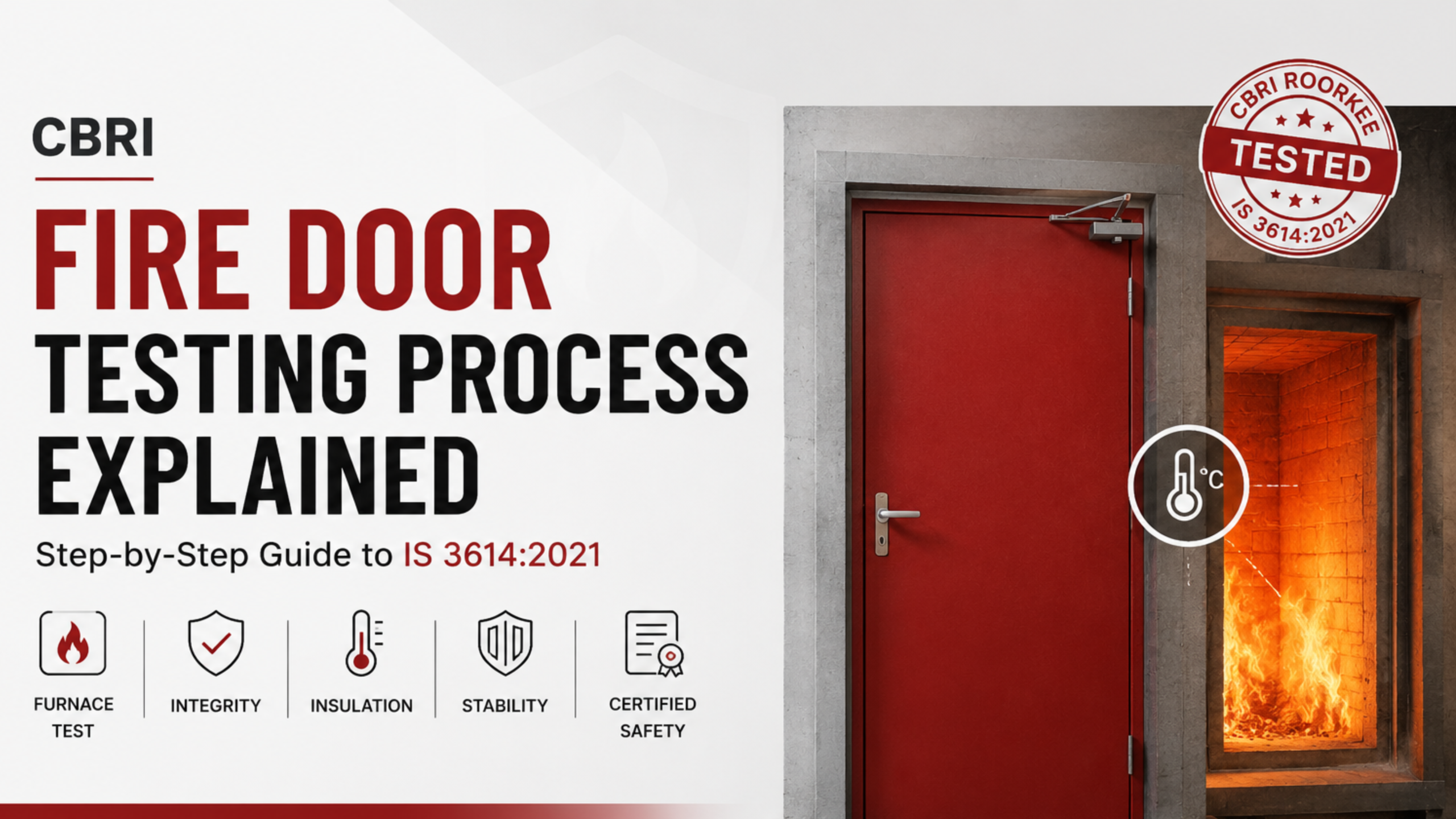
If you are specifying, buying, or manufacturing a fire rated door in India, you will hear one name again and again: CBRI. Understanding the CBRI fire door testing process helps you tell a genuinely tested door apart from one that only looks fire-rated on paper. This guide walks through every stage of the test, in plain language, from sample submission to certificate issuance, and explains how CBRI testing fits with BIS certification and the new Quality Control Order. At Pacific Fire Controls, our doorsets go through this exact process, so this article comes from hands-on manufacturing experience, not just from reading a standard.
Table of Contents
- What Is CBRI and Why Does It Matter for Fire Doors?
- The CBRI Fire Door Testing Process, Step by Step
- What Integrity, Insulation and Stability Actually Mean
- CBRI Testing vs BIS Certification vs ISI Mark
- Fire Door Ratings: What the Minutes Mean
- Testing Timeline and Certificate Validity
- BIS QCO 2025: Why CBRI Testing Is Now Practically Mandatory
- Common Mistakes Manufacturers and Buyers Make
- Expert Tips: Verifying a Genuine CBRI Test Certificate
- Benefits of Buying CBRI-Tested Fire Doors
- Key Takeaways
- Conclusion
- FAQs
What Is CBRI and Why Does It Matter for Fire Doors?
The Central Building Research Institute (CBRI), located in Roorkee, Uttarakhand, is a constituent laboratory of the Council of Scientific & Industrial Research (CSIR), established in 1947. CBRI carries out research and testing across building materials, structural safety, and fire engineering.
For fire doors specifically, CBRI runs a Fire Research Laboratory that tests full-size doorsets in a vertical furnace, replicating the way a fire resistant door would face a real fire. A CBRI test report is one of the most widely accepted forms of proof that a door meets IS 3614 requirements, and it is a required input for BIS licensing.
Other NABL-accredited laboratories, such as IPIRTI and a small number of private facilities, also test fire doors to the same standard. CBRI, however, remains the most referenced name in Indian fire door tenders and specifications, particularly for government and institutional projects.
The CBRI Fire Door Testing Process, Step by Step
Here is what actually happens when a manufacturer sends a doorset for testing.
Step 1: Sample Selection and Submission
The manufacturer submits a full-size doorset — the door leaf, frame, hinges, locks, closer, and intumescent seals — exactly as it will be sold. CBRI does not test loose components in isolation; it tests the complete assembly, because a fire safe door is only as strong as its weakest piece of hardware.
Step 2: Installation in the Test Frame
The doorset is built into a rigid test wall that matches real-world installation conditions, following the manufacturer’s own fixing instructions. This wall is then mounted directly onto the furnace opening.
Step 3: Furnace Exposure on the Standard Time-Temperature Curve
The furnace heats up following a standardised curve based on IS 3809, climbing to very high temperatures within the first few minutes and continuing to rise for the full test duration. This simulates a real, developing fire rather than a single burst of heat.
Step 4: Monitoring Integrity, Insulation and Stability
Throughout the test, engineers monitor the unexposed face using thermocouples and watch for:
- Flame or hot gas passage through gaps or joints (integrity)
- Temperature rise on the cool, unexposed side (insulation)
- Structural collapse, warping, or excessive deflection (stability)
A cotton pad test may also be used at this stage to detect any flame breakthrough around edges and gaps.
Step 5: Recording Failure Time and Assigning a Rating
Testing continues until the door fails one of the criteria above, or until it completes the target duration — 30, 60, 90, or 120 minutes — without failing. The recorded time becomes the door’s official fire resistance rating.
Step 6: Test Report and Certificate Issuance
CBRI issues a detailed test report describing the specimen, furnace conditions, observations, and the final rating achieved. Manufacturers submit this report to BIS as part of their ISI licence application, whether the product is a 30-minute internal door or a 2 hour fire rated door for a high-risk area.
What Integrity, Insulation and Stability Actually Mean
These three terms decide whether a door passes or fails, so it helps to know exactly what each one checks:
| Criterion | What It Checks | Why It Matters |
| Integrity (E) | No flame or hot gas passes through gaps, joints, or the door leaf itself | Stops fire physically spreading into the next compartment |
| Insulation (I) | Cool-side temperature stays within the permitted rise | Stops the far side from igniting nearby furniture or people |
| Stability | Door and frame stay upright and functional under fire load | Keeps the escape route usable instead of blocked by a collapsed door |
CBRI Testing vs BIS Certification vs ISI Mark: What’s the Difference?
These three terms often get used interchangeably, but they refer to different stages of the same compliance chain:
| Aspect | CBRI Testing | BIS Certification | ISI Mark |
| What it is | A physical furnace test of the complete doorset | A licensing scheme based on the test report plus a factory audit | The mark applied once a BIS licence is granted |
| Who does it | CBRI, or another BIS-recognised, NABL-accredited lab | Bureau of Indian Standards | BIS, after licence approval |
| What it proves | The tested design survives fire for a set number of minutes | The factory has consistent quality-control systems for its rated products | The specific product is licensed under IS 3614:2021 |
| Validity | Report tied to the exact tested specimen and rating | Licence renewed periodically, subject to ongoing audits | Valid only while the underlying licence is active |
Fire Door Ratings: What the Minutes Mean
A door’s rating tells you exactly how long it was proven to hold back fire in the furnace test:
| Rating | Typical Use | Example Product |
| FR 30 | Low-risk internal partitions | Standard Fire Doors |
| FR 60 | Staircases, corridors, most commercial buildings | Fire Rated Doors |
| FR 90 | High-occupancy or mixed-use buildings | Fire Resistant Door |
| FR 120 | Electrical rooms, server rooms, high-rise cores | 2 Hour Fire Rated Door |
Some projects also call for Glazed Fire Doors where visibility is required, Wooden Fire Doors for interiors needing a warmer finish, or specialised options such as Acoustic Doors, Lead Lined Doors, Clean Room Doors, and Shaft Doors for specific risk zones.
Testing Timeline and Certificate Validity
Fire door testing at CBRI or another recognised lab typically takes around 8 to 14 weeks from sample submission to final report, and lab slots fill up quickly ahead of BIS Quality Control Order deadlines. Once issued, a CBRI test certificate is generally treated as valid for about three years, after which retesting or a renewal review may be needed, alongside ongoing BIS factory audits.
BIS QCO 2025: Why CBRI Testing Is Now Practically Mandatory
The Ministry of Commerce and Industry has moved to bring fire doors and doorsets under a Quality Control Order, requiring these products to conform to IS 3614:2021 and carry the BIS Standard Mark before they can legally be sold. Under this framework, manufacturers must hold a valid CBRI, or equivalent NABL/BIS-recognised lab, test report before they can even apply for a BIS licence. In effect, this makes the CBRI fire door testing process a compulsory gate rather than an optional add-on for anyone selling fire doors in India.
Common Mistakes Manufacturers and Buyers Make
- Testing one door and selling a different one — a rating applies only to the exact specimen tested.
- Assuming timber doors are automatically covered under IS 3614 — timber fire doors generally fall under a separate standard.
- Buying doors with no traceable test report number to check against.
- Ignoring hardware substitutions after testing — a different lock or closer can void the rating.
- Treating a three-year-old certificate as automatically still valid without checking renewal status.
Expert Tips: Verifying a Genuine CBRI Test Certificate
- Ask for the full test report, not just a one-page certificate summary.
- Match the specification in the report — thickness, core material, hardware — to what is actually being supplied.
- Confirm the BIS licence number and check that it is currently active.
- Check that the rating on the door label matches the rating stated in the report.
- For large projects, ask the supplier for a sample audit or a factory visit before finalising the order.
Benefits of Buying CBRI-Tested Fire Doors
- Proven fire performance under controlled, repeatable furnace conditions
- Smoother approvals during fire NOC and occupancy certificate processes
- Lower risk during insurance surveys and safety audits
- Confidence for architects and consultants when specifying the product
- Long-term protection of life and property, not just paperwork compliance
Key Takeaways
- CBRI testing is a physical furnace test measuring integrity, insulation, and stability.
- The full doorset — leaf, frame, and hardware — is tested together, never separately.
- A CBRI report feeds directly into BIS licensing under IS 3614:2021.
- BIS QCO 2025 makes this testing effectively mandatory for legal sale in India.
- Buyers should always verify the test report itself, not just trust a label on the door.
Conclusion
The CBRI fire door testing process exists for one reason: to make sure a fire door performs when it matters most, not just on a datasheet. From furnace exposure to BIS licensing, every stage is designed to separate genuinely fire-resistant products from doors that simply look the part. Pacific Fire Controls has built its manufacturing and documentation practices around this exact process, so that architects, builders, and facility managers can specify our doors with full confidence in their tested performance.
FAQs
1. What is the CBRI fire door testing process?
It is a furnace test conducted on a complete doorset to measure how long it maintains integrity, insulation, and stability under standardised fire exposure, as per IS 3614.
2. Why is CBRI testing important for fire doors?
It gives objective proof that a door design can resist fire for its claimed rating, which is required for BIS licensing and for legal sale in India.
3. How long does CBRI fire door testing take?
Testing and reporting typically take around 8 to 14 weeks, depending on lab scheduling and demand.
4. Is CBRI the only lab that can test fire doors in India?
No. Other NABL-accredited and BIS-recognised laboratories can also test fire doors to IS 3614, though CBRI remains the most widely referenced.
5. What is the difference between CBRI testing and BIS certification?
CBRI testing is the physical fire test; BIS certification is the licensing scheme that uses that test report, along with a factory audit, to grant the ISI mark.
6. How long is a CBRI fire door test certificate valid?
Test certificates are generally treated as valid for around three years, subject to ongoing BIS factory audits.
7. Is CBRI testing mandatory under the new BIS QCO?
Yes. Under the Quality Control Order for fire doors and doorsets, products must conform to IS 3614:2021 and carry the BIS Standard Mark, which requires a valid recognised-lab test report.
8. Can I sell a fire door without CBRI or equivalent testing?
Once the QCO is in force, selling fire doors without a valid BIS licence backed by recognised lab testing is not permitted.
9. Does CBRI test timber fire doors the same way as steel doors?
Steel fire doors are primarily covered under IS 3614, while timber fire doors are generally addressed under a separate standard, so buyers should confirm which standard applies to their product.
10. How can I check if a fire door’s CBRI certificate is genuine?
Request the full test report, match the specification to the supplied product, and verify that the associated BIS licence number is active.