
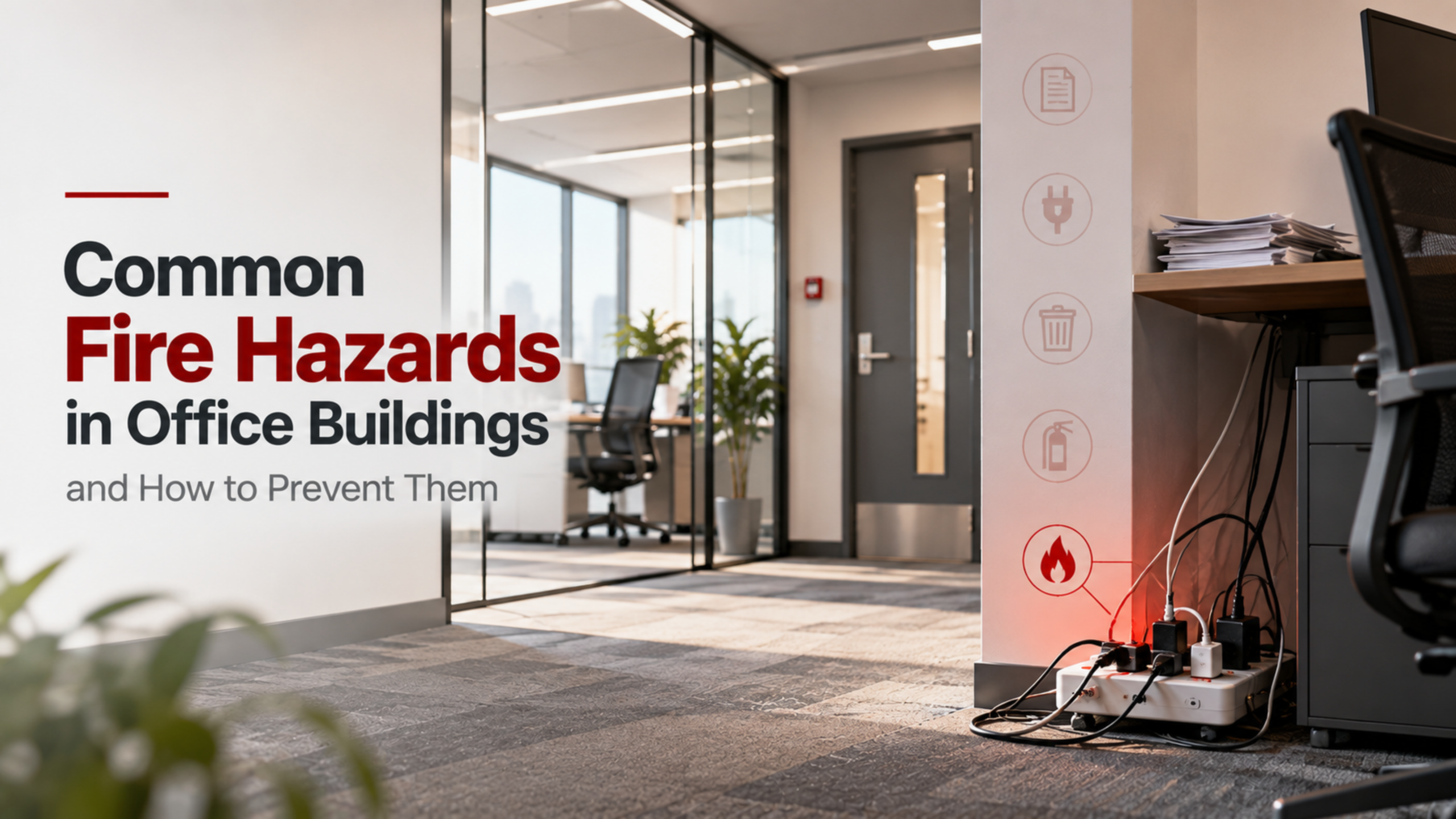

Office buildings have a reputation for being low-risk environments when it comes to fire — no industrial machinery, no flammable chemicals, no open flames in most workspaces. That reputation isn’t entirely wrong, but it creates a dangerous blind spot. Offices burn down every year, and the causes are rarely dramatic. They’re mundane: an overloaded extension board under a desk, a space heater left running overnight, a fire door wedged open for airflow, a cluttered storeroom nobody’s inspected in months. None of these looks like a fire hazard on an ordinary Tuesday. All of them are.
The ordinary, everyday nature of office fire hazards is precisely what makes them dangerous — they don’t announce themselves the way a chemical spill or an industrial accident would. They accumulate quietly, in the background of daily operations, until one bad moment brings them together. Understanding where these hazards typically hide, and what practical steps reduce them, is the foundation of genuine office fire safety — not just the fire extinguisher on the wall and the evacuation map nobody reads.
This guide walks through the most common fire hazards found in office buildings and the practical, mostly low-cost steps that meaningfully reduce each one.
1. Electrical Hazards: The Single Biggest Category
Electrical issues are consistently identified as one of the leading causes of office fires, and for good reason — modern offices run on electricity far more intensively than the buildings they often occupy were originally designed for.
Overloaded sockets and extension boards. Hot-desking, laptops, chargers, monitors, and personal devices mean far more equipment is plugged in per desk than older electrical layouts were built to handle. Daisy-chaining multiple extension boards, or stacking too many devices into a single socket, causes current draw beyond what the wiring was designed to safely carry — generating heat that can ignite nearby materials.
Faulty or ageing wiring. Frayed cords, cracked sockets, and old wiring not upgraded to handle modern electrical loads are a persistent risk, particularly in older commercial buildings that have seen multiple tenant fit-outs over the years without a full electrical system review.
Server rooms, UPS systems, and battery backups. IT and server rooms concentrate significant electrical load and heat generation in a small space, and uninterruptible power supply (UPS) battery systems carry their own fire risk if not properly ventilated and maintained.
Prevention steps:
- Avoid daisy-chaining extension boards; use properly rated, surge-protected power strips, and add permanent wall sockets in high-demand areas rather than relying on extension leads long-term
- Schedule regular electrical inspections, including fixed wiring testing, especially in older buildings or after any office renovation
- Replace damaged cords, cracked sockets, and worn plugs immediately rather than continuing to use them
- Ensure server rooms and UPS/battery areas have adequate ventilation, dedicated circuits, and are included in fire safety inspection routines, not treated as a sealed-off technical space nobody checks
2. Kitchen and Pantry Equipment
Nearly every modern office has some form of pantry or kitchenette — a kettle, microwave, toaster, or coffee machine — and these spaces generate a disproportionate share of office fire incidents relative to their small physical footprint.
Unattended cooking or heating equipment. Something left on a hot plate or in a toaster, forgotten while someone steps away, is a classic and entirely preventable ignition source.
Faulty or poorly maintained appliances. Office kitchen appliances often see heavy daily use with minimal maintenance attention compared to equipment used in a dedicated commercial kitchen.
Prevention steps:
- Never leave cooking or heating appliances unattended, even briefly
- Establish a routine maintenance and replacement schedule for shared kitchen appliances
- Keep flammable materials (paper towels, packaging) away from heating equipment
- Switch off and, where practical, unplug kitchen appliances at the end of each day
3. Combustible Materials and Poor Housekeeping
Paper, cardboard, packaging, and general office clutter don’t ignite on their own, but they provide abundant fuel for a fire that starts elsewhere — turning a small, containable ignition into a fast-spreading one.
Accumulated paper and cardboard. Storerooms, under-desk areas, and archive spaces often accumulate paper waste and packaging over time, especially where recycling or disposal routines aren’t consistently followed.
Cluttered escape routes. Boxes, furniture, or equipment stored in corridors and near exits don’t just fuel a fire — they actively obstruct evacuation and emergency responder access when it matters most.
Combustible interior finishes. Office fit-outs sometimes use materials like MDF partitions, certain laminates, or foam-backed false ceiling panels that can contribute meaningfully to fire spread and smoke generation if not selected with fire performance in mind.
Prevention steps:
- Maintain a regular waste disposal and recycling routine, particularly for paper-heavy departments
- Keep corridors, stairwells, and exit routes completely clear of stored items, even temporarily
- Specify fire-rated or fire-retardant materials for interior fit-out elements, particularly partitions and ceiling systems, during renovation or new fit-out planning
- Conduct periodic housekeeping walkthroughs specifically looking for combustible clutter accumulation, not just general tidiness
4. Smoking and Improperly Discarded Materials
Even in offices with strict no-smoking policies indoors, designated outdoor smoking areas and improperly discarded smoking materials remain a recognised fire risk, particularly where ashtrays or disposal bins aren’t positioned safely away from combustible materials or building entrances.
Prevention steps:
- Ensure designated smoking areas are located away from building entrances, windows, and combustible storage
- Provide proper, non-combustible disposal receptacles for smoking materials
- Enforce no-smoking policies in and around sensitive areas like storage rooms, server rooms, and loading docks
5. HVAC Systems, Dust Accumulation, and Mechanical Rooms
Heating, ventilation, and air conditioning systems are easy to overlook as a fire risk because they’re largely out of sight, but they carry real hazards of their own.
Dust and lint accumulation. Dust builds up gradually on electrical equipment, within HVAC ducting, and around machines that generate heat — computers, printers, HVAC motors — and can become a fire hazard if left unaddressed, since dust is itself combustible and can also insulate heat-generating components, pushing them toward higher operating temperatures than intended.
Electrical panel and switchgear rooms. These rooms concentrate significant electrical infrastructure and carry elevated fire risk if not kept clear of stored materials and properly maintained.
Generator and DG (diesel generator) rooms. Common in Indian commercial buildings as backup power infrastructure, these rooms combine fuel storage, electrical systems, and mechanical heat generation — a combination that warrants dedicated fire safety attention, including appropriate fire-rated compartmentation separating them from occupied office areas.
Prevention steps:
- Schedule regular cleaning of HVAC systems, including duct and filter maintenance
- Keep electrical panel and switchgear rooms clear of stored materials, and ensure they’re included in routine fire safety inspections
- Verify generator and DG rooms have appropriate fire-rated doors and compartmentation separating them from occupied spaces, with fuel storage handled according to applicable safety norms
6. Hot Work During Renovation and Fit-Out
Office buildings rarely stay static — tenants move in and out, spaces get renovated, and fit-out work involving welding, cutting, or soldering (“hot work”) introduces a temporary but serious fire risk that’s easy to underestimate precisely because it’s temporary.
Prevention steps:
- Implement a hot work permit system for any renovation or maintenance activity involving welding, cutting, or open flame
- Ensure fire extinguishers and a fire watch are present during and immediately after hot work activities
- Clear combustible materials from the hot work area before starting, and avoid scheduling such work near storage areas or during occupied hours wherever possible
7. Compromised Passive Fire Protection: Propped-Open Doors and Blocked Systems
This category deserves particular emphasis because it doesn’t involve a new ignition source at all — it involves disabling the very systems designed to contain a fire once one starts, regardless of cause.
Fire doors propped or wedged open. Whether for ventilation, convenience, or simply because a closer wasn’t working and nobody reported it, a fire door held open provides no fire or smoke resistance during exactly the moment it might be needed. This is one of the most common and entirely preventable compliance failures in office buildings, and it undermines compartmentalisation regardless of how the fire actually started.
Blocked or obstructed fire extinguishers and hydrants. Furniture, boxes, or decor items placed in front of fire safety equipment can delay or prevent its use during an actual emergency.
Disabled or neglected alarm and detection systems. Smoke detectors covered, disconnected, or left unmaintained after a false-alarm incident are a surprisingly common finding during office fire safety audits.
Prevention steps:
- Train staff and facility teams on why fire doors must never be propped open, and address disabled or malfunctioning closers immediately rather than letting staff work around them
- Keep fire extinguishers, hydrants, and alarm call points completely unobstructed at all times
- Include fire door and detection system checks as a standing item in regular facility walkthroughs, not just during formal annual audits
8. Lack of Staff Training and Fire Drills
Even a building with excellent physical fire protection can fail its occupants if staff don’t know what to do during an actual emergency — where the nearest exit is, how to use an extinguisher, or what the evacuation assembly point actually is.
Prevention steps:
- Conduct regular fire drills, commonly recommended at least twice a year, so evacuation procedures become familiar rather than theoretical
- Train designated fire wardens on each floor to assist with orderly evacuation and headcount procedures
- Display clear, visible evacuation route signage and ensure it stays current after any office layout change
9. Basement Parking and Vehicle-Related Risks
Where office buildings include basement or ground-level parking, vehicles themselves — along with associated electrical systems like EV charging points — introduce a distinct fire risk profile, given the combination of fuel, electrical systems, and often limited ventilation in enclosed parking areas.
Prevention steps:
- Ensure basement-to-building interfaces have appropriately fire-rated doors and compartmentation, limiting fire and smoke spread from a parking area into occupied floors
- Install and maintain appropriate fire detection and suppression systems specific to parking area risk
- Follow manufacturer and local safety guidance for any EV charging infrastructure installed in parking areas
10. Arson and Deliberate Fires
While less common than accidental causes, deliberate fire-setting remains a recognised risk category for commercial buildings, and basic access control and security measures play a role in reducing this risk alongside the broader prevention measures covered above.
Prevention steps:
- Maintain appropriate access control for the building, particularly after hours
- Ensure external areas, waste storage, and less-monitored zones are included in security patrols and camera coverage
- Report and investigate any suspicious activity around the building promptly
Why Passive Fire Protection Matters Regardless of the Cause
Everything covered so far addresses how fires start. But a comprehensive office fire safety strategy also has to plan for the reality that, despite prevention efforts, a fire might still occur — from a cause nobody anticipated, in a building with otherwise excellent housekeeping and maintenance. This is where passive fire protection — fire-rated doors, walls, and compartmentation — earns its place as a non-negotiable backstop, not a redundant precaution.
Passive fire protection doesn’t care what caused the fire. A correctly specified, properly maintained fire door will hold back flame and smoke for its rated duration whether the fire started from an overloaded socket, an unattended kettle, or a dust-clogged server room fan. This is precisely why fire door compliance — genuine BIS certification under IS 3614:2021, correctly functioning self-closing devices, intact seals, and doors that are never propped open — matters as much as any of the active prevention measures discussed above. Prevention reduces the likelihood of a fire starting; compartmentation determines how much damage it does if one does.
Office buildings that invest heavily in hazard prevention but neglect fire door maintenance are only solving half the problem. Likewise, buildings with excellent fire doors but poor electrical housekeeping are simply waiting for an ignition source to test a system that shouldn’t have to work as hard as it will.
A Practical Fire Hazard Prevention Checklist for Office Buildings
Electrical:
- ✅ No daisy-chained extension boards; surge-protected power strips only
- ✅ Regular fixed wiring inspection, especially in older buildings
- ✅ Damaged cords and sockets replaced immediately, not patched temporarily
Kitchen and pantry:
- ✅ No unattended cooking or heating equipment
- ✅ Scheduled maintenance for shared appliances
Housekeeping:
- ✅ Regular paper/cardboard waste disposal routine
- ✅ Corridors and exits kept completely clear at all times
- ✅ Fire-rated or fire-retardant materials specified for interior fit-outs
Mechanical and service areas:
- ✅ HVAC systems cleaned and maintained on schedule
- ✅ Electrical panel rooms and DG rooms kept clear and properly compartmented
Renovation and hot work:
- ✅ Hot work permit system in place for any welding, cutting, or open flame activity
Passive fire protection:
- ✅ Fire doors never propped open; closers checked and functional
- ✅ Fire extinguishers and hydrants kept unobstructed
- ✅ Detection and alarm systems maintained and tested regularly
People and procedures:
- ✅ Fire drills conducted at least twice a year
- ✅ Floor-wise fire wardens designated and trained
- ✅ Evacuation signage current and clearly visible
Quick Recap
- Most office fire hazards are ordinary, everyday conditions — overloaded sockets, unattended kitchen equipment, cluttered exits — rather than dramatic or unusual events, which is exactly what makes them easy to overlook.
- Electrical issues remain one of the most significant hazard categories in office buildings, driven largely by modern equipment demands outpacing older electrical infrastructure.
- Passive fire protection, especially correctly maintained fire doors and compartmentation, matters regardless of what actually causes a fire, and should never be treated as secondary to active prevention measures.
- Regular inspection, housekeeping, staff training, and fire drills turn fire safety from a one-time compliance checkbox into an ongoing operational habit.
- A genuinely fire-safe office combines hazard prevention (reducing ignition sources) with compartmentation (limiting damage if ignition still occurs) — neither alone is sufficient.
FAQs
What is the most common cause of fire in office buildings? Electrical issues — including overloaded sockets, faulty wiring, and damaged equipment — are consistently identified as among the leading causes of office fires, often compounded by modern electrical demands exceeding what older building wiring was designed to handle.
Are small office kitchens really a significant fire risk? Yes. Unattended cooking or heating equipment and poorly maintained appliances in office pantries and kitchenettes are a recurring cause of workplace fire incidents, disproportionate to the small size of these spaces.
Why is propping a fire door open considered such a serious hazard? A fire door provides no fire or smoke resistance while held open, regardless of how briefly, which means the exact moment it’s propped open for convenience could be the moment it was actually needed to contain a fire.
How often should office fire drills be conducted? Fire safety guidance commonly recommends conducting fire drills at least twice a year, helping staff stay familiar with evacuation routes and procedures rather than relying on theoretical knowledge during an actual emergency.
Does cluttered storage really contribute to fire risk, or is it just a tidiness issue? Accumulated paper, cardboard, and general clutter provide fuel that can accelerate fire spread once ignition occurs from another source, and clutter near exits specifically obstructs evacuation and emergency responder access — making it a genuine fire safety issue, not just a housekeeping preference.
What’s the difference between fire prevention and fire protection in an office building? Fire prevention focuses on reducing the likelihood of a fire starting (electrical maintenance, housekeeping, hot work controls), while fire protection — particularly passive measures like fire-rated doors and compartmentation — limits how much damage occurs if a fire does start, regardless of its cause.
Do server rooms and UPS battery areas need special fire safety attention? Yes. These spaces concentrate significant electrical load and heat generation in a small area, and should be included in regular fire safety inspections, with adequate ventilation and dedicated circuits rather than being treated as a sealed, low-attention technical space.
Can good fire prevention practices eliminate the need for fire-rated doors and compartmentation? No. Even well-maintained offices with strong prevention practices can experience an unexpected fire, which is why passive fire protection measures like certified fire doors remain essential as a backstop, independent of how effective hazard prevention efforts are.
Reducing fire hazards in an office building means tackling both sides of the equation — preventing ignition sources and ensuring the building’s passive fire protection actually works when it’s needed. Pacific Fire Doors manufactures BIS-certified fire-rated doors and doorsets under IS 3614:2021, giving facility managers and building owners a reliable compartmentation backstop that holds up regardless of what ultimately causes a fire to start.