
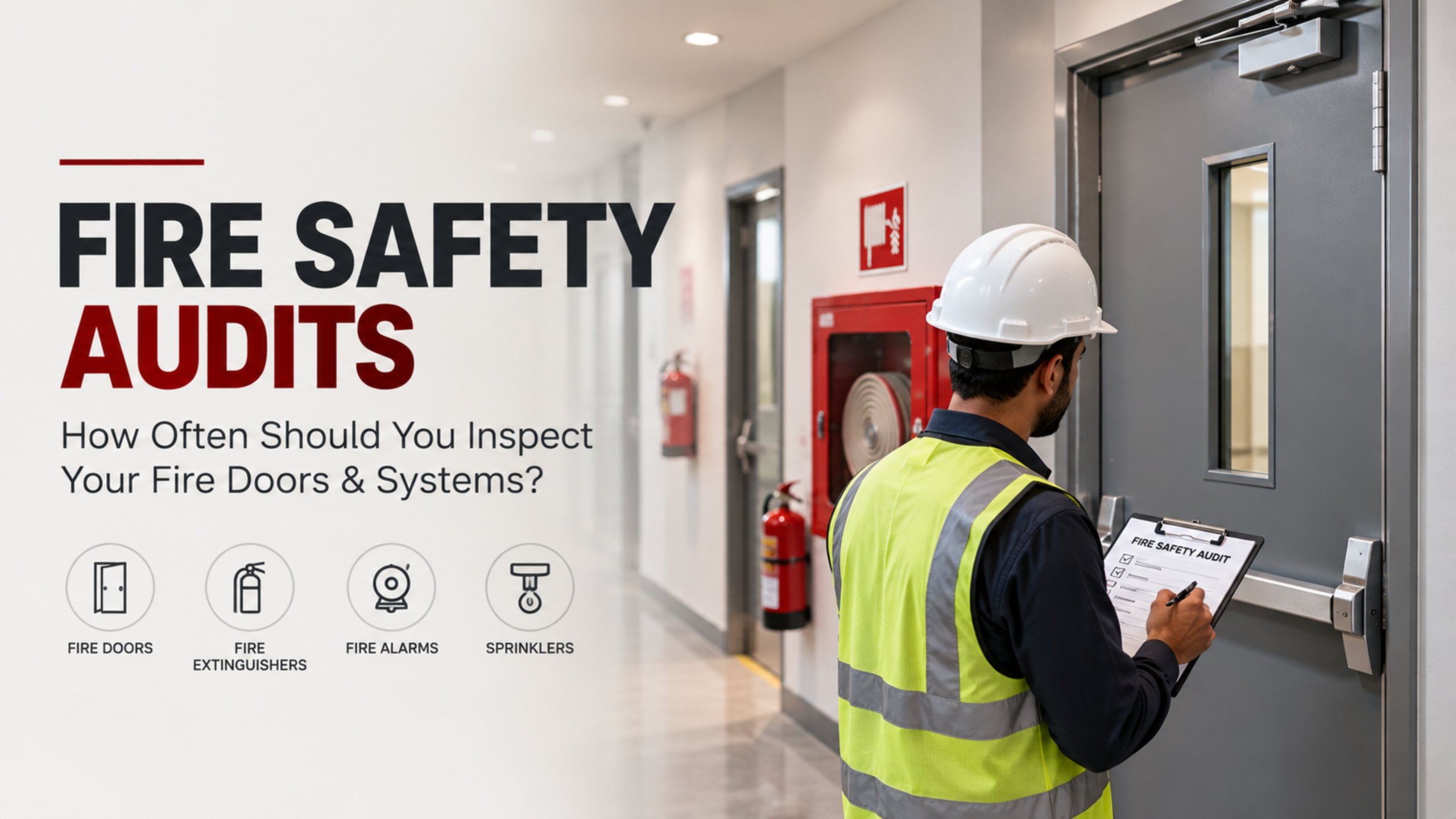

A building can pass its Fire NOC inspection on day one and still be dangerously non-compliant five years later. Fire doors lose their seals. Hydrant pumps lose pressure. Alarm panels drift out of calibration. None of this happens overnight, and none of it necessarily shows up in daily use — which is exactly why fire safety isn’t a one-time approval you get and then forget. It’s an ongoing obligation that needs a clear, deliberate inspection schedule behind it.
The question building owners, facility managers, and architects ask most often isn’t whether to inspect fire safety systems — most people accept that’s necessary. It’s how often, and what exactly needs checking at each interval. The honest answer is that it depends on what you’re inspecting (a building-wide audit is a different exercise than a single fire door check), what type of building you’re managing, and which state’s fire safety rules apply to your project. This guide breaks that down clearly.
Fire Safety Audit vs. Fire NOC: Two Different Things
Before getting into frequency, it’s worth clearing up a confusion that trips up a lot of building owners: a Fire NOC and a fire safety audit are not the same thing.
- A Fire NOC (No Objection Certificate) is issued by the state fire department, confirming that a building met fire safety requirements at the time of inspection. It’s mandatory before occupancy, and it needs periodic renewal — but it’s essentially a point-in-time approval.
- A fire safety audit is a more detailed, ongoing verification process, often conducted by a licensed third-party auditor, that checks whether a building’s fire safety systems — including fire doors, alarms, suppression systems, and escape routes — are still functioning as intended, independent of whether the NOC happens to be due for renewal at that moment.
Put simply: the Fire NOC tells you a building was compliant in the past, while a fire safety audit tells you whether it’s still compliant now. Relying solely on NOC renewal cycles to catch fire safety issues means problems can go unnoticed for years between renewals, especially in states where renewal periods stretch to three or even five years.
What the National Building Code Says About Audit Frequency
The National Building Code (NBC) 2016, Part 4 (Fire and Life Safety) includes a specific provision for Fire and Life Safety Audits, which applies to buildings above 15 metres in height. Under this provision, such audits are expected to be carried out by a third-party auditor with relevant fire and life safety inspection experience, at a recommended frequency of once every two years.
It’s important to understand two things about this provision:
- NBC is fundamentally recommendatory in nature at the national level — it becomes legally binding only once adopted into a state or municipal building bye-law. Most states have incorporated NBC’s fire safety recommendations into their own regulations to varying degrees, which is why actual audit requirements differ noticeably from state to state.
- The two-year NBC benchmark is a general guideline for buildings above 15 metres, not a universal rule for every occupancy type. Higher-risk occupancies — hospitals, industrial facilities, and assembly buildings with large occupant loads — are commonly expected to follow more frequent audit cycles, often annually, reflecting their elevated risk profile.
How Fire NOC Renewal Periods Vary by State
Because fire safety regulation in India operates through state-level rules layered on top of the NBC framework, Fire NOC renewal periods vary meaningfully depending on location and building type. Based on commonly cited patterns across Indian states:
| Building Type | Typical Fire NOC Renewal Period |
|---|---|
| Commercial buildings | Often annual, though some states allow up to 3 years |
| Residential societies / apartment complexes | Commonly 3 to 5 years |
| Industrial facilities | Often annual |
| Hospitals | Frequently annual, given the higher occupancy risk |
Some states layer additional requirements on top of basic NOC renewal — for instance, requiring quarterly self-assessments by the building owner alongside an annual third-party audit, even where the formal NOC itself is valid for a longer period. These figures are illustrative of general patterns, not a substitute for checking your specific state’s current fire safety rules, since renewal periods, audit mandates, and enforcement practices continue to evolve, and exact requirements are legally determined at the state level.
How Often Should Fire Doors Specifically Be Inspected?
This is where building-wide audit cycles and fire door-specific inspection schedules need to be understood as separate (though related) things. A building’s overall Fire NOC might be valid for three years, but that doesn’t mean its fire doors should only be checked once every three years — fire door-specific maintenance operates on its own, tighter cadence.
General recommendation: at least annual, detailed inspection of every fire door assembly.
This benchmark is widely referenced internationally — for instance, under NFPA 80 (the US standard for fire doors and other opening protectives, commonly used as an informal best-practice reference by fire safety consultants globally), fire door assemblies are expected to be inspected and tested at minimum annually, with records retained for several years as evidence of ongoing compliance. While NFPA 80 isn’t the governing Indian standard, its annual inspection principle reflects sound, widely accepted practice that Indian facility managers and fire safety consultants commonly apply as a baseline, regardless of what a specific state’s statutory minimum might technically allow.
Higher-frequency inspection for specific contexts:
- High-traffic doors — staircase enclosures, lift lobbies, and other doors cycled constantly throughout the day — benefit from more frequent checks than low-traffic doors, since wear accumulates faster with heavier use.
- Healthcare settings — ICU, operation theatre, and other critical care area doors are commonly recommended for quarterly hardware and seal checks, given both the intensity of daily use and the dual fire-safety and infection-control stakes involved in these areas.
- Automatic release and alarm-linked doors — doors that close automatically upon fire alarm activation (such as basement-to-building interface doors) benefit from more frequent functional testing, since their correct operation depends on an integration with the alarm system that needs its own verification.
- After any modification or repair — any time a fire door undergoes repair, hardware replacement, or an adjacent renovation that could have affected its seals or clearances, it should be re-inspected promptly rather than waiting for the next scheduled annual check.
Daily and routine visual checks, conducted by facility staff rather than a certified inspector, also play a valuable role between formal inspections — checking that doors aren’t propped open, that closers are functioning, and that no obvious damage has occurred — even though these informal checks don’t replace a proper annual, detailed inspection.
What a Complete Fire Door Inspection Should Cover
A genuine fire door inspection goes well beyond confirming the door opens and closes. At minimum, it should check:
- Certification label — present, legible, and matching the door’s claimed fire-resistance rating and manufacturer details
- Door and frame condition — checking for warping, cracks, rust, dents, or any damage that could compromise structural integrity
- Clearances and gaps — verifying the gap between the door leaf and frame falls within acceptable tolerances at the top, sides, and bottom
- Seals — confirming intumescent and smoke seals are present, undamaged, and not painted over or obstructed
- Hardware function — hinges, latches, and locks operating correctly, with no missing or incorrect fixings
- Self-closing performance — confirming the door closes fully and latches every time, without needing to be forced or adjusted manually
- Glazing condition, where applicable — confirming vision panels are intact, with glazing beads securely fitted
- Signage and documentation — verifying any required fire door signage is present and inspection records are up to date
Most of these checks require a trained eye, since several of the most consequential issues — gap expansion, seal degradation, subtle hardware wear — aren’t obvious during casual daily use. This is why a formal annual inspection by a qualified person matters, even in buildings where doors are visually checked more frequently by general facility staff.
What a Full Fire Safety Audit Covers Beyond Fire Doors
Fire doors are one part of a much broader system that a complete fire safety audit evaluates. A thorough audit typically covers:
- Fire detection and alarm systems — functionality, coverage, and audibility across all floors
- Fire suppression systems — sprinklers, hydrants, hose reels, and fire pumps, including pressure and flow testing
- Fire extinguishers — correct type, capacity, accessibility, and service dates
- Means of escape — staircase condition, exit signage visibility, emergency lighting backup, and clear, unobstructed escape routes
- Electrical safety — checking for overloaded circuits, faulty wiring, and other ignition risks, since electrical faults remain one of the leading causes of fires in commercial buildings
- Storage of hazardous or flammable materials — verifying safe storage practices and appropriate compartmentation
- Access for fire services — confirming fire tenders and emergency responders can actually reach the building and its hydrant systems without obstruction
- Staff training and fire drill records — many state regulations expect documented evidence of regular fire drills, commonly at least twice a year, along with staff training on evacuation procedures
- Conformity with NBC and local building regulations — cross-checking the building’s actual condition against its approved fire safety drawings and any conditions attached to its Fire NOC
Fire doors sit within this broader system as a passive protection element, working alongside active systems like alarms and sprinklers — which is why a fire door that passes inspection in isolation still needs to be assessed as part of the complete fire safety picture during a full audit.
Who Should Conduct Fire Safety Audits and Inspections
Fire safety audits are generally expected to be carried out by licensed, competent third-party auditors — professionals with relevant fire and life safety inspection qualifications, such as a fire engineering background, an industrial safety diploma, or accreditation from a recognised fire safety institution. Using an independent third party rather than relying solely on internal staff adds a layer of impartiality that many state fire departments specifically require as part of Fire NOC renewal, particularly for higher-risk occupancies.
For fire door-specific inspections, the inspector should ideally be familiar with the specific certification requirements under IS 3614:2021 and the testing basis under IS 17518 (Part 1):2022, so they can accurately assess whether an installed door still matches its certified configuration — not just whether it opens and closes normally.
Documentation and Record Retention
Thorough documentation is just as important as the inspection itself, for a simple reason: an inspection that isn’t recorded is functionally invisible during an audit or legal review. Good practice includes:
- Maintaining a written, dated, and signed record for every inspection, including the inspector’s name and qualification
- Recording specific findings and any corrective actions taken, not just a generic “passed” or “failed” notation
- Retaining inspection records for several years — commonly cited international best practice suggests retaining fire door inspection records for a minimum of three years, though many facility managers retain records for the life of the building or door assembly
- Keeping records readily accessible for review, since fire departments and auditors will typically expect to see this documentation on request during a Fire NOC renewal or a surprise inspection
For buildings with a large number of fire doors — hospitals, large commercial complexes, high-rise residential towers — maintaining a fire door register, tracking each individual door’s location, certification details, and inspection history, makes this documentation far more manageable than relying on scattered paper records or memory.
Consequences of Skipping or Delaying Inspections
The risks of neglecting fire safety audits and fire door inspections extend across several dimensions:
- Safety risk — the most direct consequence: a fire door or system that has quietly drifted out of compliance may fail to perform when it’s actually needed, directly increasing risk to occupants during a real fire.
- Fire NOC suspension or rejection — fire departments can suspend an NOC or refuse renewal if equipment is found missing, damaged, or non-functional during inspection, directly affecting a building’s legal ability to operate.
- Legal and regulatory exposure — under various state Fire Services Acts and, for certain occupancies, the Factories Act 1948, periodic fire safety audits are a legal requirement, not merely a recommended best practice, and non-compliance can carry direct legal consequences.
- Insurance implications — insurers increasingly expect documented evidence of regular fire safety audits and maintenance, and gaps in this documentation can affect claims processing after an incident.
- Costlier remediation — issues caught early during routine inspection are almost always cheaper and less disruptive to fix than problems discovered during a formal audit failure, a Fire NOC rejection, or worse, after an actual fire.
Common Mistakes in Fire Safety Audit Scheduling
- Treating Fire NOC renewal as the only audit event, overlooking the need for more frequent, detailed fire door and system inspections in between renewal cycles.
- Applying a single inspection frequency across the whole portfolio, without adjusting for higher-risk occupancies (hospitals, industrial facilities) that typically warrant more frequent checks.
- Using unlicensed or unqualified inspectors, which can result in audit reports that don’t hold up to fire department scrutiny or genuinely catch underlying issues.
- Inconsistent or missing documentation, leaving a building unable to demonstrate compliance history even if inspections did technically occur.
- Overlooking fire doors as a distinct inspection item within a broader fire safety audit, treating them as a minor checklist line rather than a system that needs its own detailed assessment.
- Delaying corrective action after an inspection identifies an issue, allowing a known deficiency to persist until the next scheduled inspection cycle.
A Practical Inspection Frequency Reference
| Item | Recommended Minimum Frequency |
|---|---|
| Fire door detailed inspection (general buildings) | At least annually |
| Fire door checks in healthcare/high-use areas | Quarterly, in addition to annual detailed inspection |
| Full building fire safety audit (buildings above 15m) | At least once every 2 years (NBC baseline); often annual for high-risk occupancies per state rules |
| Fire NOC renewal | Every 1–5 years depending on state and building type |
| Fire drills | At least twice a year |
| Daily/routine visual checks (facility staff) | Ongoing, as part of normal building operations |
Always confirm the specific frequency requirements that apply to your building type and state, since these figures reflect commonly cited general practice rather than a single universal rule applicable to every project.
Quick Recap
- A Fire NOC and a fire safety audit serve different purposes — the NOC confirms past compliance, while an audit verifies ongoing, current compliance.
- NBC 2016 recommends fire and life safety audits every two years for buildings above 15 metres, though state rules and higher-risk occupancies often call for more frequent cycles.
- Fire doors specifically should be inspected in detail at least annually, with more frequent checks for high-traffic and healthcare settings, regardless of how long a building’s overall Fire NOC remains valid.
- A thorough audit covers fire doors alongside detection, suppression, escape routes, electrical safety, and staff training — not any single system in isolation.
- Documentation, retained consistently and in detail, is what actually proves compliance during a Fire NOC renewal, insurance review, or legal inquiry.
FAQs
Is a Fire NOC the same as a fire safety audit? No. A Fire NOC is a certificate issued by the fire department confirming compliance at a point in time, while a fire safety audit is a more detailed, often third-party-led assessment of whether fire safety systems are genuinely functioning on an ongoing basis.
How often does NBC 2016 recommend a fire safety audit? NBC 2016 recommends a fire and life safety audit at least once every two years for buildings above 15 metres in height, though this is a general guideline, and specific state regulations or higher-risk occupancy types may require more frequent audits.
Should fire doors be inspected more often than the overall building audit? Yes, generally. Fire doors are commonly recommended for detailed annual inspection, which may be more frequent than a building’s overall Fire NOC renewal or fire safety audit cycle, since door-level wear accumulates through daily use independent of the building’s broader audit schedule.
Who is qualified to conduct a fire safety audit in India? Fire safety audits are generally expected to be conducted by licensed, competent third-party auditors with relevant fire and life safety inspection qualifications, often required for impartiality, particularly for higher-risk occupancies and Fire NOC renewal purposes.
What happens if a building skips its scheduled fire safety audit? Skipping scheduled audits can result in Fire NOC suspension or renewal rejection, legal exposure under applicable state fire safety regulations, insurance complications, and — most importantly — an increased real-world safety risk if fire systems have quietly drifted out of compliance.
How long should fire door inspection records be kept? Commonly cited best practice suggests retaining fire door inspection records for a minimum of three years, though many facility managers retain records for the full life of the building or door assembly to support long-term compliance tracking.
Do all buildings need a fire safety audit, or just high-rises? While NBC 2016’s specific audit provision applies to buildings above 15 metres, many state fire safety rules extend audit and inspection requirements to a broader range of occupancies, particularly commercial, industrial, and healthcare buildings regardless of height — so it’s worth checking your specific state’s requirements rather than assuming height is the only trigger.
Can internal facility staff conduct fire door inspections instead of an external auditor? Routine daily or weekly visual checks by facility staff are valuable and recommended between formal inspections, but the detailed annual (or more frequent) fire door inspection is best conducted by a qualified, ideally third-party, inspector familiar with the relevant certification standards, since several key issues aren’t detectable through casual visual checks alone.
A fire safety audit is only as good as the systems it’s inspecting — and a fire door that was never genuinely certified under IS 3614:2021 will struggle to perform consistently, inspection after inspection, regardless of how diligently it’s checked. Pacific Fire Doors manufactures BIS-certified fire-rated doors and doorsets designed for durable, long-term performance, backed by traceable documentation that helps building owners and facility teams keep their fire door inspection records audit-ready year after year.